

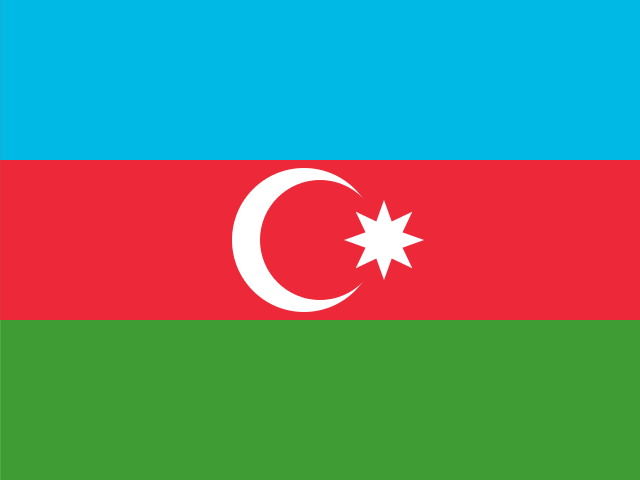
Azerbaijan
In Azerbaijan, the human capital development, vocational education and training (VET) and skills system is undergoing a significant transformation to address the challenges of our fast-changing world. Ensuring that human capital skills meet the needs of a greener and low-carbon economy is crucial. These changes in the education system pave the way for new jobs and increased prosperity for citizens.
ETF activities in Azerbaijan build on national policy priorities aimed at offering citizens opportunities for lifelong learning.
The EU’s first regional programme supporting education reforms and skills in the Eastern Partnership region was formally launched in Turin in May 2024. This EUR 2.5 million, three-year (2024–26) programme – to be implemented by the ETF – aims to enhance the efficiency, quality, equity, equality and relevance of education systems in five countries of the region, including Azerbaijan.
The ETF cooperates with the Agency for Vocational Education, under the Ministry of Science and Education, in implementing the Torino Process and supporting the monitoring of progress in human capital development. Additionally, the ETF partners with the ministry in the implementation of SELFIE, a tool designed to empower schools in harnessing the potential of digital technologies for enhanced teaching and learning experiences.
The ETF has been cooperating with the National Observatory on Labour Market and Social Protection Affairs since its establishment in 2020 – supporting the country in building a modern labour market information system which, among other objectives, should guide the reform of the education and training system.
The ETF provides strategic input to the EU Delegation to Azerbaijan and the European Commission by actively participating in the European Union’s country programming cycle. This encompasses the shaping of interventions within the EU Annual Action Programme 2018 and the provision of insights into human capital development within the EU Multiannual Indicative Programme 2021–2027 for Azerbaijan.
Furthermore, the ETF is providing progress monitoring of the EU-funded project VET for the Future supporting the modernisation of VET institutions, implemented by the United Nations Development Programme.
Read our 2025 update on Key policy developments in education, training and employment (ETF, 2025). For a quick update, see below:
2025 developments at a glance
⚖️ Economic and policy developments: Azerbaijan continues implementing the Socio-Economic Development Strategy 2022–2026 and the Azerbaijan 2030 National Priorities, with a strong focus on human capital development, economic diversification and labour market inclusion. In 2025, additional employment measures targeted vulnerable groups, green skills and post-conflict reconstruction needs.
🌍 Post-conflict recovery and reconstruction: The implementation of the Great Return Programme continued, supporting the return of internally displaced persons to liberated territories. Reconstruction efforts are creating new demand for skills in construction, infrastructure, logistics, public services and renewable energy.
🏫 Vocational education and training (VET): Azerbaijan continued implementing reforms under the Strategic Roadmap for the Development of VET and the Socio-Economic Development Strategy 2022–2026. VET participation continues to grow, new occupational standards and curricula are being introduced, and work is ongoing to strengthen qualifications, quality assurance and links with employers. New programmes in areas such as renewable energy, electric vehicles and drone maintenance reflect changing labour market demand.
🛠️ Work-based learning: Dual VET programmes expanded further between 2023 and 2025, with increased participation by institutions and employers. Work-based learning continues to be integrated into curricula, although employer engagement and apprenticeship opportunities remain relatively limited compared to programme ambitions.
💼 Labour market developments: Employment rates remain comparatively high and unemployment low, although a large share of workers continue to be engaged in vulnerable forms of employment. Active labour market measures have expanded significantly, covering more than 300,000 individuals in 2024 through employment services, training, self-employment and career guidance programmes.
👦 👧 Youth in focus: The share of young people not in employment, education or training (NEETs) continued to decline gradually, reaching 19.1% in 2024. Azerbaijan has also participated in initiatives inspired by Youth Guarantee principles through EU4Youth programmes that strengthen entrepreneurship, career guidance and youth employability.
💻 Digital skills development: Azerbaijan continued expanding digital education initiatives. The Digital Skills Project reached more than 500,000 students, while the STEAM programme continued to expand across schools. The 4IR Academy, developed with Coursera, is supporting digital skills development in areas such as AI, data and programming, while EU4Digital initiatives continue to promote digital literacy and cybersecurity skills.
🌱 Green skills development: Green transition priorities became increasingly visible across education and training policies following COP29. New qualifications and training programmes in renewable energy, sustainable agriculture and environmental technologies are being introduced, while green skills are increasingly integrated into vocational curricula and labour market programmes.
📚 Adult learning and lifelong learning: Participation in adult learning is growing through continuing VET and active labour market programmes, but overall participation remains low. Azerbaijan continues expanding vocational training centres, validation of prior learning and opportunities for upskilling and reskilling, particularly for unemployed people and vulnerable groups.
Priorities for 2026
👉 Support the further implementation of the National Qualifications Framework, including qualification placement, recognition of prior learning and stronger alignment with European and international frameworks.
👉 Strengthen quality assurance arrangements across education and VET, with greater emphasis on graduate outcomes, transparency and institutional independence.
👉 Expand work-based learning, dual education and employer engagement to improve the relevance of skills development and labour market outcomes.
👉 Promote digital and green skills, supporting economic diversification, innovation and the transition to a low-carbon economy.
👉 Increase participation in adult learning and continuing VET, particularly for employed adults, women and vulnerable groups, while expanding opportunities for reskilling and upskilling.