Automatic translation into Arabic is available for this page.Translate this page
Publications
This catalogue contains all ETF publications available to download, including studies on our partner countries, corporate publications and statutory documents. All publications are free of charge.
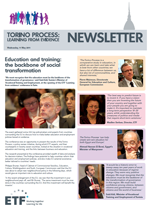
This is the first newsletter relating to the "Learning from evidence" event. The event, held in Turin from 9 to 11 May 2011, gathered most of the ETF partner countries involved in the Torino Process.
The following document presents a compendium of key data, challenges and priorities facing partner countries in the reform of their VET policies and systems.
Teachers for the Future is a regional report that draws together and analyses research findings from a study commissioned by the European Training Foundation (ETF) in seven countries in theWestern Balkan region, namely Albania, Bosnia and Herzegovina, Croatia, the former Yugoslav Republic of Macedonia, Kosovo2, Montenegro and Serbia.
This country report reviews the vocational and technical education (VTE) system and policies in Lebanon. The study was launched by the European Training Foundation (ETF) in 2010 to provide a concise evidence-based analysis of the VTE subsector.
The present report has been produced in close consultation with the EU Delegation and Bosnia and Herzegovina stakeholders including the Ministry of Civil Affairs, the Agency for Pre-primary Primary and Secondary Education, the canton Ministries of Education and Employment bureaus and Social Partner Institutions.
This document provides a survey of Israel's plans to increase the number of students in technological and vocational tracks, and in technological schools; and to invest in educational infrastructures, including advanced workshops and laboratories in schools, and regional technology centres. It also describes the ‘Technicians with Matriculation’ (Tech-Mat) programme, the ‘Springboard to Industry’ programme, programmes to develop a cadre of professional teaching staff for technological education, and refresher courses for teachers in cooperation with industry. It includes a proposal to offer special compensation to technology education teachers so that their salaries compete with those in the industrial sector. This would include remuneration for mentoring projects and developing innovative programmes.
As part of the 2010 Torino Process, and following a request by the European Commission's Directorate-General for Education and Culture, the ETF has also launched a study on the co-operation between education and business in all its partner countries. In Jordan, the ETF country team has worked closely with the secretariat of the E-TVET Council to gather and analyse evidence of policies, trends, bottlenecks and challenges. In April, ETF organised two focus group meetings at which the main stakeholders were represented. In early July, the draft reports of both the VET review and the education and business study were discussed with the same stakeholders.
This country report covers the review of the vocational education and training (VET) system and policies in Tajikistan. The study was launched by the European Training Foundation (ETF) in 2010 to provide a concise, documented analysis of VET reform in the country.