
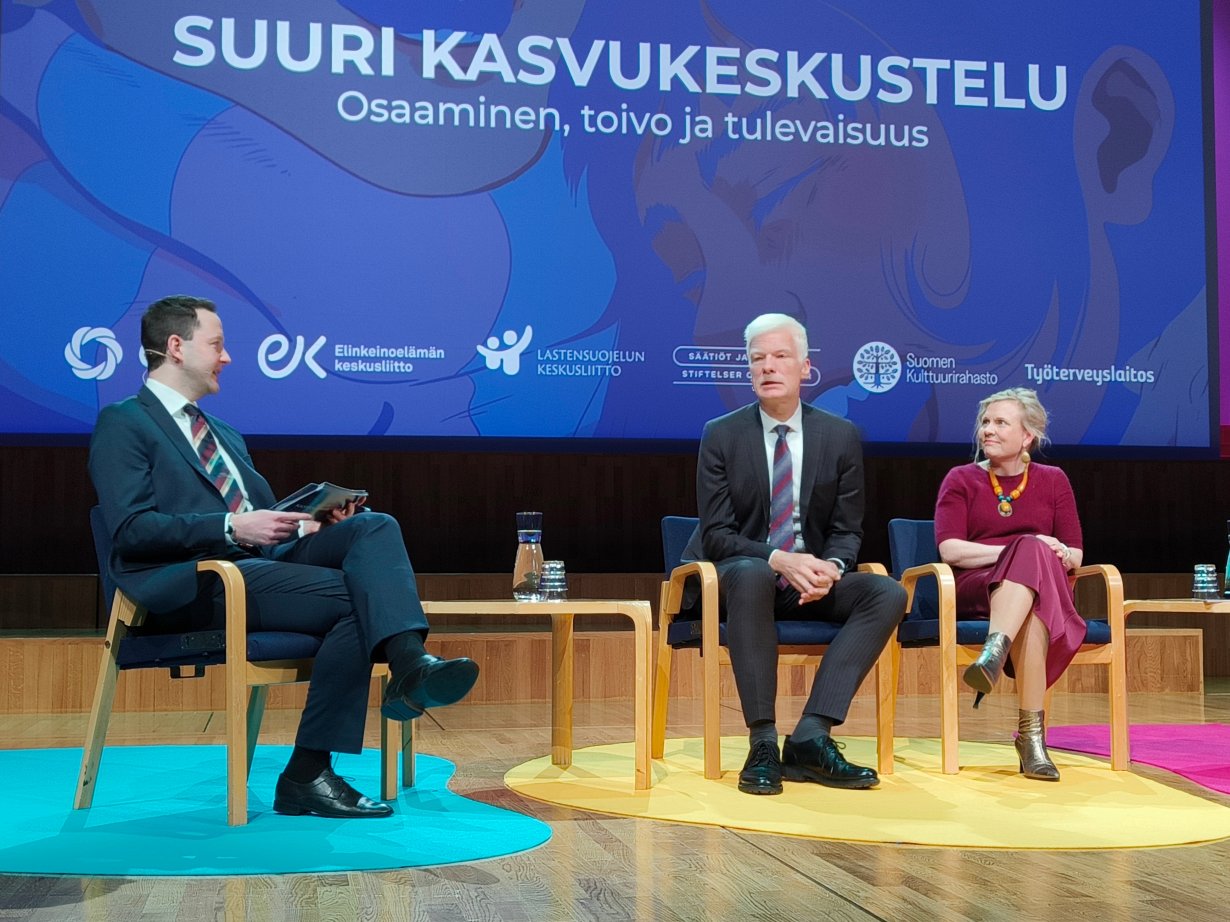
OPINION PIECE - Why skills development matters in a fragmented world
Pilvi Torsti, Director of the European Training Foundation (ETF)
Andreas Schleicher, Director for Education and Skills at the Organisation for Economic Co-operation and Development (OECD)
To say that the global economy is entering a more volatile phase is hardly a scoop. Growing turbulence has been affecting the world. In times like these, skills stop being “solely” a social policy and become the wiring that keeps economies functioning.
The logic behind this may seem simple: when people learn more, societies have the chance to flourish. In Finland, raising the basic level of proficiency of the entire population through the comprehensive school model could generate massive long-term economic gains. But the situation is more multifaceted than it appears.
Education helps individuals upskill, yet what people learn often does not match what economies need. According to the OECD’s Survey of Adult Skills, about one-third of workers across OECD countries are mismatched to their jobs, whether in terms of their qualifications, skills or fields of study. Furthermore, economies often fail to convert better skills into better jobs and lives. This is visible across EU countries, but also across the EU neighbourhood. According to ETF data, in Georgia, employment rises from 17% among adults with low education to 63% among those possessing higher levels—yet it remains far below the 80%+ typical within the EU. It is like opening more doors but finding too few rooms behind them.
For businesses, this tension between education and employment is not an abstract phenomenon. When a manufacturing company in Tampere invests in advanced machinery, but cannot find technicians to operate and maintain it, this matters. When a clean tech firm in Vaasa struggles to scale because engineers with the right combination of technical and applied skills are in short supply, this matters too.
Skilled migrants are helping firms grow, but their potential is often not fully recognised, because of barriers when it comes to skills recognition, integration, and matching skills to jobs. In countries where growth relies on exports, innovation, and high-value production, skills gaps are not just a HR issue—they are a direct constraint on investment, productivity and competitiveness.
And turbulence continues to put entire systems to the test. Economic instability, displacement and political tension can be highly disruptive. In many countries, the basic beams that hold education up—funding, infrastructure, access, links to work—are the elements under the greatest strain.
At a time when relying on past practice is not always the best guide to the future, countries increasingly look outwards to learn from and with other countries. This is where organisations like the ETF and the OECD come in, supporting countries to reform their education, training and labour market systems. The guiding principle is clear: even when everything else shifts, we must continue to strengthen the foundations that enable continued learning.
Ukraine illustrates the importance of this. Here, the OECD and the ETF are supporting Ukraine’s education and training systems, for example, through bringing the experience of OECD countries with upper secondary reform to supporting Ukraine with the implementation of its New Ukrainian School, or through the introduction of the EU-supported “Youth Guarantee” in Ukraine, a Finnish-led policy that has had a considerable positive impact on an entire generation of learners.
Within this context, AI continues to raise the stakes. When it comes to emerging skills – AI, digital or green – the world is in the same boat. We are no longer living in a time when these were a private, individual asset; in tightening markets, they are becoming a public commodity. This makes unity and cooperation in skills development essential.
We need to foster a system where companies, education providers and public services work together to anticipate new skill needs; where skills are renewed throughout the course of one’s life; and where the sharing of skills is treated as the strongest form of investment. Just last week, Business College Helsinki – one of Finland’s largest vocational institutions – ran a series of workshops in Tanzania on how to build effective digital learning environments with limited resources. This typifies such a progressive approach.
There is no competitiveness without competences. Skills are not a secondary policy domain. They are the foundation of long-term growth – and hopefully, stability and peace. In times of such upheaval, investing in skills is among the ways we can help stimulate and preserve these as we move forward.
This op-ed was originally published in Finnish-language weekly Talouselämä on 30 March 2026.
Media relations
- Daria Santucci, +39 366 963 9638, mediarelations@etf.europa.eu
- Leo Chapman, +39 375 102 1024, mediarelations@etf.europa.eu