

Supporting youth employment and skills development in the EU neighbourhood
Guided by EU policies and practice, the ETF provides policy advice and guidance for the reform of education and labour market systems to support youth employment, engagement and inclusion in partner countries in the EU's neighbourhood. In cooperation with other organisations at national, regional, European and international levels we undertake targeted studies, interventions and regular policy progress monitoring which takes into account the socio-economic characteristics of each country and focuses on the most vulnerable groups, as outlined below.
Understanding NEETs (Not in Employment, Education, or Training)
Although prior to the COVID-19 pandemic, youth unemployment was declining in the ETF partner countries in South Eastern Europe and Turkey, and the Eastern Partnership regions, and to a lesser degree in Central Asia, the ETF’s latest round of the Torino Process 2018-2020 found that in 2020, on average, one in every four young people in the ETF partner countries were not in education, training or employment (NEET) and women were disproportionately represented. This figure rises to one in three young people for the Southern and Eastern Mediterranean region. A particular policy challenge identified is that for many, being a NEET appears to be a choice.
Young people not in employment, education or training (NEETs) by country (2016-20)
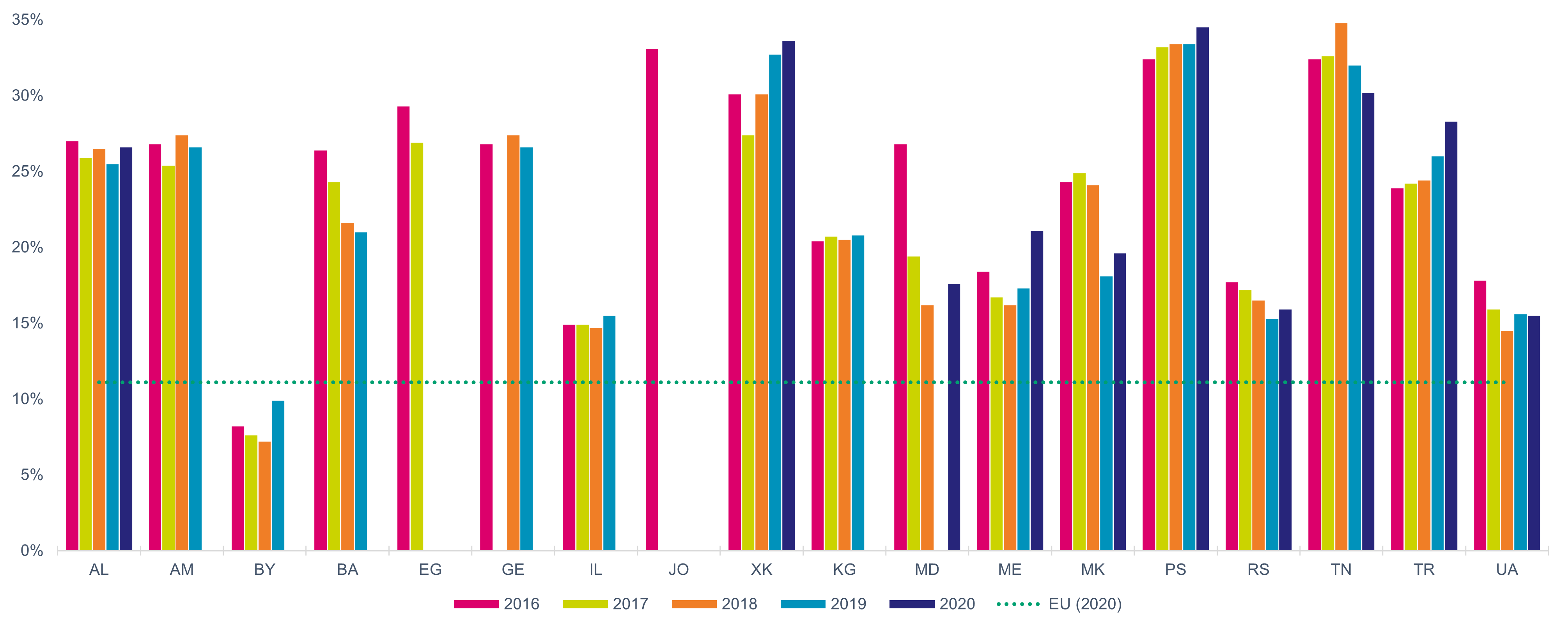
Notes: data for Armenia, Egypt, Georgia, Jordan, Kyrgyzstan, Tunisia and Ukraine: ETF calculations based on Labour Force Survey microdata; data for Moldova: estimated using usual resident population. Wources: ETF 2020, Eurostat
In the Southern and Eastern Mediterranean an ETF study explores the reason why such large numbers of young people are in the NEET category. These include an economic volatility which limits employment opportunities and hampers capacity for adequate investment in socioeconomic development, an under-developed private sector, high numbers of school dropouts, occupation mismatch due to inadequate or irrelevant schooling, and also a large number of educated women inactive in the labour market due to domestic commitments.
Public-private partnerships
In South Eastern Europe and Turkey the education prospects of young people are more promising with an improvement in the skills generated through upper secondary, including vocational education and training (VET), and tertiary education, helped by collaboration between schools and the business sector and private sector engagement in delivering internships and apprenticeships. More information on the value of public-private partnerships with case studies from the Western Balkans and Turkey can be found in the ETF publications presented at an event jointly hosted by the European Training Foundation and the Western Balkans 6 Chamber Investment Forum (WB6 CIF).
The ETF supports a broad engagement of stakeholders in partner countries in the design, implementation and adaptation of national policies on education, skills and employment and together with the employer representatives and trade unions recognises the vital contribution of civil society.
Skills intelligence
Our work is informed by regular monitoring and evaluation together with national stakeholders as with the Torino Process, the Osnabruck Declaration Process, thematic and country based data collection and analyses and regular events bringing together key stakeholders. Policies need to reconcile various goals to enhance education, skills and employment including ensuring the protection of rights, particularly in emerging areas as with platform workers discussed in the ETF event "Innovation and Adaptation of Active Labour Market Policies to Changing Economic and Social Conditions".
Overcoming exclusion of young people is a multifaceted issue and policy measures must address the unique situation of those already already at risk due for example to their gender, ethnicity, disability or migrant status. For the latter, the ETF is working to improve skills intelligence on migration to help young migrants build their skills and secure employment.
Education and training
Ensuring equality of opportunity in the labour market, particularly in new and changing sectors resulting from the digital and green transitions requires quality, inclusive and efficient education and training for lifelong learning, and inclusive access and outreach with the recognition of non-formal and informal learning.
Micro-credentials can be a tool to bring short courses and credentials into the qualification system in order to enhance initial employment and upskilling pathways for young people, and to provide additional learning opportunities for vulnerable groups and those who have dropped out of formal education. Check out the ETF’s latest policy brief ‘Micro-Credentials are Taking Off’ about how they are supporting upskilling and reskilling in response to transformations in labour markets.
In partnership with other organisations, the ETF supports the development of appropriate skills and competences through the enrichment and reform of the curriculum with the help of the EUs competence development frameworks (DigComp, GreenComp, LifeComp, and EntreComp), the development of qualifications frameworks, recognition of prior learning, and professional development of teachers and trainers. Our work is supported by a series of learning networks such as the ETF Network of Vocational Excellence (ENE), the Community of Innovative Educators, and the GLAD network which supports partnerships and enhances the contribution of multiple stakeholders to the governance of vocational education and training, skills development and lifelong learning. We are also supporting the institutional readiness of schools through the EU’s SELFIE tool.
Career guidance
Better integrated labour market and skills information systems and solid career guidance can help young people in all the EU’s neighbourhood regions to navigate in uncertain and volatile labour markets as presented in a joint publication by six international organisations including the ETF, “Investing in Career Guidance”. Career development strategies can also be embedded within wider policy areas, including reskilling and upskilling programmes such as the Youth Guarantee Scheme.
Financing
New financial and capacity-building instruments are also needed to promote and spur impact investment that will ensure a robust and agile private sector, support youth programmes and activities, ensure sustainability in skills creation and retention, reduce brain drain and support the creation of high value-added jobs, as highlighted in the publication from the European Commission’s Joint Research Centre and the ETF which is focused on the Western Balkans region, “Exploration of Impact investment for Skills Creation”.