Automatic translation into Dutch is available for this page. Translate this page

Publications

This catalogue contains all ETF publications available to download, including studies on our partner countries, corporate publications and statutory documents. All publications are free of charge.

Date range
1174 items
  • 2007
    This working doucment presents the results of a study that looked at poverty and skills issues in a number of regions in Kyrgyzstan. It focuses in particular on the role of vocational education and training (both formal and non-formal) in reducing poverty, and on the possibilities for the reform of the vocational education and training system to improve its role.
  • 2008
    In 2005 the European Training Foundation (ETF) started in-depth studies on the challenges and prospects of labour market and vocational education and training (VET) in Armenia, Azerbaijan and Georgia.
  • 2007
    This publication looks at the importance of the role of secondary education in the development of education around the world, as modern economies and their labour markets need people with sophisticated knowledge, skills and competences that cannot be developed only in primary school or in low-quality secondary schools. The publication highlights the position of the secondary education in the OECD countries, and the need to secure access to better quality secondary education for all students in order to have a responsive and flexible upper secondary education system that simultaneously serves the needs of employers and lifelong learning.
  • 2007
    This report presents the state of play of the human resources development system in the West Bank...
  • 2008
    This publication summarises main outcomes of the ETF Innovation and Learning Project 'Transition from Education to Work' that was implemented in 2006-2007. The project aims at studying the link between education and work in a dynamic and integrated way. The main innovative element is the development of new conceptual approaches and analytical instruments for the ETF and its partner countries. The objective of the project was to develop two different tools to analyse the transition from education to work in ETF partner countries in order to better understand the links between education, training and labour market integration of young people. First, a conceptual and analytical framework on the topic of transition from education to work was developed and used for national reports on transition from education to work in Egypt, Serbia and Ukraine. This project builds on earlier work within the MEDA-ETE project implemented by the ETF whereby a thematic study on the transition from education to work in Europe was prepared based on discussions on the relevance of European experiences with a network of MEDA experts and policymakers. Secondly, a methodology for a school-leaver survey was developed and implemented in Serbia and Ukraine. This methodology takes as its starting point the ad hoc module on school-to-work transition within the framework of the European Labour Force Survey in 2000 and integrates key specific features of the EU neighbourhood where the ETF works.
  • 2007
    The ETF Yearbook 2007 identifies qualification as the pivot connecting national qualification frameworks, schools, headmasters, teachers and trainers, and learning processes. Different components of quality development are analysed in six chapters that assess how they contribute to increased quality learning: - National qualification frameworks – facilitating policy learning in practice - Vocational schools in transition - Teachers and trainers in countries in transition - National qualification frameworks: a tool for relating learning and employability in the MEDA region - Fostering key competences - The dichotomy between educational ‘policies’ and the reality of ‘politics’ in transition countries. The ETF Yearbook 2007 links the (local and decentralised) organisation of learning processes to overall national qualification frameworks.
  • 2006
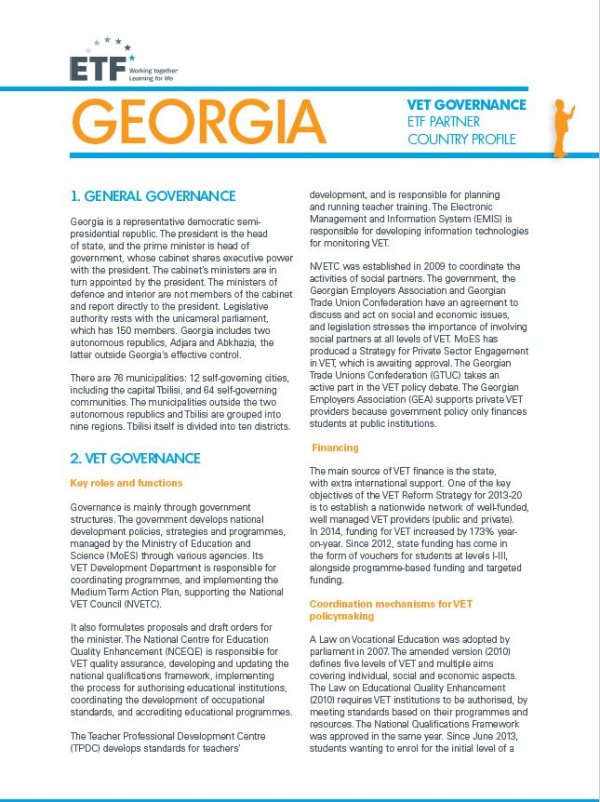
    This in-depth study on Georgia looks in detail at the labour market and the vocational education system in the country. It examines in particular the challenges that will face the country in view of its participation in the EU's new European Neighbourhood and Partnership Instrument.
  • 2008
    This report presents the outcomes of two evaluation projects implemented in Russia and Morocco with a common aim: to assess public training policies. In the Russian case a qualitative, interpretative approach was applied to evaluate the impact of management training, whereas in the Moroccan case a quantitative approach was applied to evaluate the impact of in-service training. The difficulties encountered whilst carrying out these impact evaluations are described as well as the merits and limitations of the different evaluation models applied.
  • 2007
  • 2007