
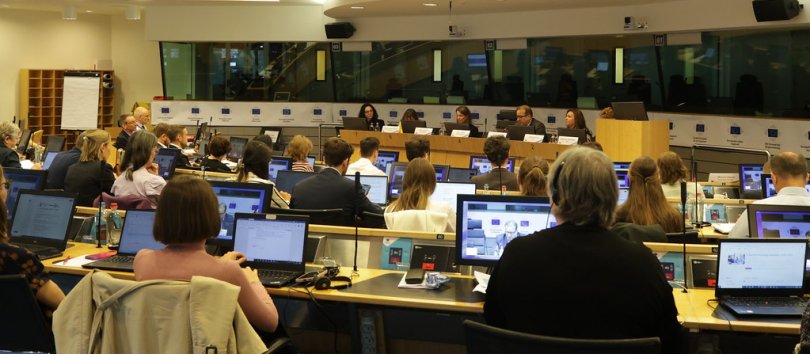
Social dialogue, AI and digitalisation: Tripartite Exchange Seminar (TES) 2026 kicks off with online session
How should Europe’s social partners respond to the rapid rise of artificial intelligence in the workplace? That's the question set to shape discussions at the upcoming Tripartite Exchange Seminar (TES) 2026, to be held in Brussels on 10–12 June. Today's first module consisted of an online session, which offered an initial glimpse of the key themes, from digital transformation and skills to working conditions and human-centred AI.
A joint, multi-agency initiative, the TES is coordinated by Eurofound, Cedefop, EU-OSHA and the European Training Foundation (ETF). Adopting the theme of “digital and artificial intelligence and the role of social dialogue”, the seminar will bring together social partners and representatives of national and local government from EU Member States, the Western Balkans, Ukraine and Moldova. In an era where rapid digitalisation and increasingly pervasive AI continue to reshape work organisation, skills needs and working conditions, the seminar aims to strengthen participants’ capacity to effectively engage in social dialogue on such issues.
Today’s online meeting reasserted the TES as a prime opportunity for social partners to address the growing challenges they face, serving as an informative jumping-off point ahead of the June residential session. The latter will dive deeper, facilitating mutual engagement on how to leverage the benefits of new technology for economies and workers alike, while seeking to mitigate its adverse effects. A particular emphasis will be placed on human-centric approaches to digitalisation and AI, in line with European values and social rights.
With a diverse range of stakeholders invited to weigh in, the event will offer participants the chance to explore social dialogue from a national, sectoral and cross-sectoral perspective. Through the creation of practice groups, it will also provide a space for sustained exchange, laying the groundwork for longer-term peer learning beyond the seminar itself, with the goal of boosting participants’ network capacity and methodological knowledge-sharing.
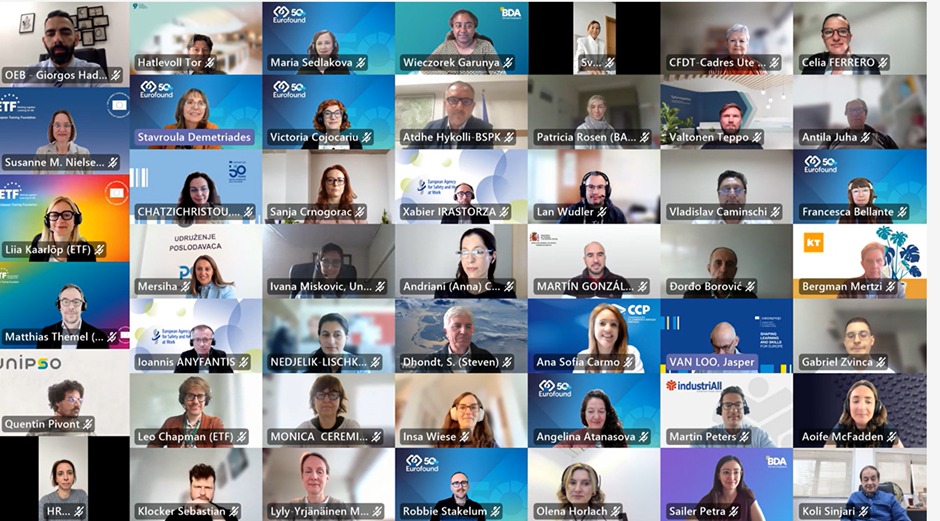
A shared space for social learning
Using tangible, real-world examples, social partners and government representatives will exchange on social dialogue practices that address AI and digitalisation's impact on workplaces, skills, job quality, productivity, and the economy at large. Learning from each other’s experience of how to address common challenges, participants will identify strategies that promote inclusive productivity, decent working conditions and relevant skills development. The event is also an opportunity for candidate countries to network with EU counterparts, in support of their preparation for EU accession.
Speaking at today’s session, Garunya Wieczorek, Principal Adviser at BDA, the Confederation of German Employers’ Association, referenced the 2024 edition, stating that:
"the seminar created a space to jointly explore the concept of a fair, just transition, using interactive formats that really encouraged active participation. What I found particularly valuable was the diversity of actors. You meet social partners from across countries, but also institutions that approach the same topic from very different angles."
Presenting his evidence on the interplay between social dialogue and digitalisation and AI, KU Leuven Senior Research Scientist Steven Dhondt stated:
"There is always a lot of uncertainty regarding the performance of workers, but now, with AI, there is also uncertainty regarding how such technology functions in practice, particularly when it transpires that it is not always doing what we expect it to. In some cases, it can abolish jobs, yet not necessarily deliver on the promise of productivity – here, we need to also consider collaboration and skills-driven industrial policy with a focus on human centricity."
What to expect in June
June’s residential session will be hosted by the European Economic and Social Committee (EESC) in Brussels. Through various formats and hands-on exercises, participants will actively engage in practical problem-solving and peer-to-peer learning. Dedicated sessions with experts from the four agencies will also be provided.
The themes covered in the seminar broadly fall into three main categories:
- Block 1: “Digitalisation and AI for better work and jobs”
- Block 2: “Joint responsibility for skills”
- Block 3: “Health and safety in workplaces integrating digital and AI technologies”
Did you like this article? If you would like to be notified when new content like this is published, subscribe to receive our email alerts.