
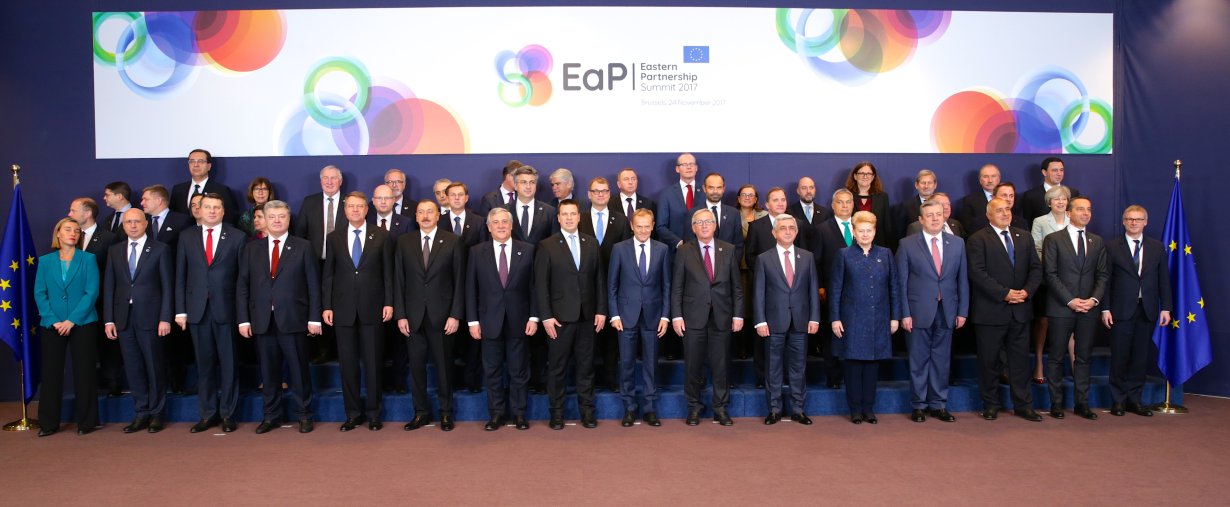
Empowering youth: outcomes of the Eastern Partnership summit
A reinforced ‘Youth Package’ with a particular focus on leadership, mobility and quality of formal and non-formal education, and the creation of an Eastern Partnership European School – these are some of the key conclusions of the Eastern Partnership Summit that took place in Brussels on 24 November. Leaders from EU countries and Armenia, Azerbaijan, Belarus, Georgia, Moldova and Ukraine met to agree on the future priorities for partnership. Together they discussed how to strengthen cooperation and achieve stronger economies, governance, connectivity and societies.
"We want to reinforce Eastern Partnership cooperation in a number of specific areas such as small and medium-sized enterprises, digital economy, broadband investments, and investments in transport, energy and infrastructure projects. The list is long. But above all, we want to strengthen links between our citizens and give more support to civil society", said EU Council President Tusk.
All leaders agreed on a joint declaration reconfirming their commitment and the high importance they attach to the Eastern Partnership. Among the points of relevance for education and training, the leaders agreed on the following:
"18. Investment in young people's skills, entrepreneurship and employability will be substantially strengthened, notably with a reinforced "Youth Package" presented by the EU under the EU4Youth initiative, which will include a new mobility scheme for young people and targeted actions through youth engagement roadmaps with a particular focus on leadership, mobility and quality of formal and non-formal education. Young people and youth workers will profit from increased opportunities of mobility under the Erasmus+ programme. The participation of partner countries to Erasmus+, Creative Europe, COSME and Horizon 2020 programs opens up new mobility opportunities for universities, administrations, businesses, professionals, cultural and audio-visual operators, young people students and researchers and contributes to developing cultural and creative industries. Reinforced cooperation in EU programmes will be supported where relevant and applicable.
19. An Eastern Partnership European School will be established, taking into consideration the activities of EU Member States, to provide high quality education to pupils from partner countries, increase their educational and employment opportunities, promote cooperation, multi-cultural understanding, tolerance, fundamental values, a better understanding of the European Union and its engagement in the region, as well as enhance language skills. A network of partner countries' universities will focus on excellence in teaching."
Leaders also welcomed 20 deliverables for 2020, a framework aiming to improve the lives of citizens across the Eastern partners in the four priority areas of cooperation identified in Riga in 2015.
Background
The Eastern Partnership was launched in 2009 to promote political association and economic integration between the EU and the six Eastern European partner countries: Armenia, Azerbaijan, Belarus, Georgia, the Republic of Moldova and Ukraine. The next summit is foreseen for 2019.
Did you like this article? If you would like to be notified when new content like this is published, subscribe to receive our email alerts.