
EU and Central Asia meet in Ashgabat to build skills for the Trans-Caspian Transport Corridor
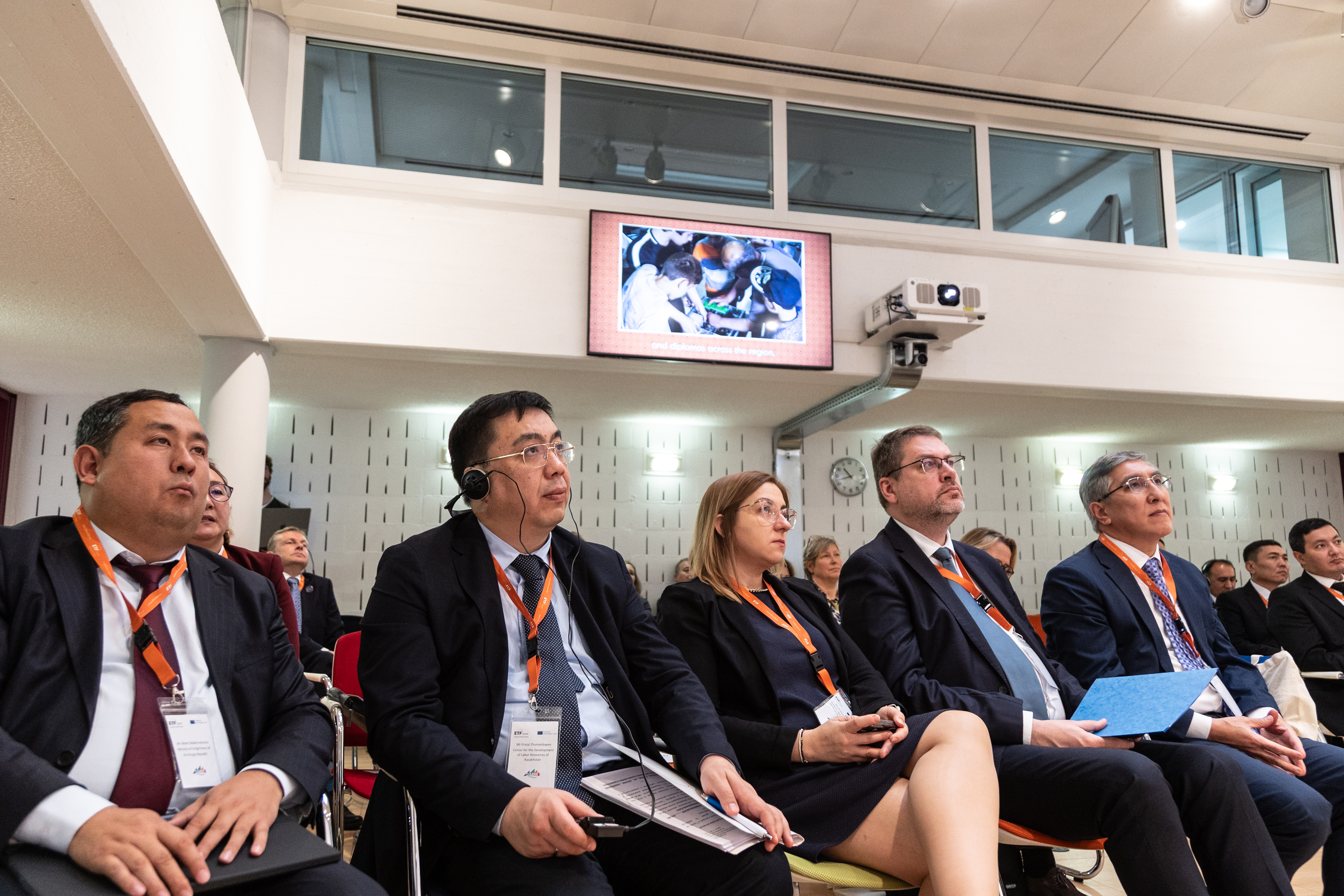
The fifth DARYA High-Level Group meeting brings together Deputy Ministers and senior officials of education and labour from five Central Asian countries to link skills with European Union (EU) Global Gateway investments
Ashgabat, 12 October 2026 – Deputy Ministers and senior officials of education and labour from Kazakhstan, Kyrgyzstan, Tajikistan, Turkmenistan and Uzbekistan will gather in Ashgabat on 13 and 14 October for the fifth High-Level Group meeting in the framework of EU-funded DARYA project (Dialogue and Action for Resourceful Youth in Central Asia).
Under the title "Building the skills dimension of the Trans-Caspian Transport Corridor", the meeting adopts a fully sector-focused approach, examining the role of skills in supporting investments under the Global Gateway strategy. The meeting will focus on how EU-backed strategic connectivity investments in the region are supported by skills, to deliver lasting economic and social benefits, including jobs and opportunities for young people in Central Asia.
The meeting gathers Deputy Ministers and senior officials of the five Central Asian countries and Eduards Stiprais, EU Special Representative for Central Asia. Representatives of the European Commission's DG INTPA will present the Global Gateway investment context, alongside the European External Action Service, EU Delegations in the region, the European Bank for Reconstruction and Development (EBRD), EU Member State partners and business and sector representatives.
“For three decades, the European Training Foundation has supported Central Asian countries in reforming education, training and labour markets, and DARYA has brought that expertise into a regional conversation. Countries have moved from exchanging experience to building shared references and evidence on skills,” said ETF Director Pilvi Torsti. “This matters now. Global Gateway investments, including in the Trans-Caspian Transport Corridor, will deliver only if people are trained to run them and qualifications are understood across borders. A region that shares skills references can function as one connected socio-economic space, with better opportunities for its people. There is no competitiveness without competences, and there is no return on economic and human capital investment without skills.”
DARYA is a €10 million EU-funded programme, implemented by the European Training Foundation (ETF), that supports inclusive, labour-market relevant skills development and regional policy dialogue across the five Central Asian countries. The High-Level Group is its annual platform for strategic dialogue among Deputy Ministers of Education and Labour, and other senior officials with skills and qualifications mandates, including heads of VET committees and qualifications agencies.
What DARYA has delivered
Since 2022, DARYA has supported the education and employment systems in the region to develop further, with national ownership at the centre. Working groups from Kazakhstan, Kyrgyzstan, Tajikistan and Uzbekistan have developed six prototype multi-country occupational profiles, including truck driver and logistics warehouse specialist, which offer voluntary references for national standards and training programmes. A joint study of residential energy efficiency in Kazakhstan and Tajikistan applies a shared methodology using technology foresight to analyse needs for future skills, professions and occupations, while each country keeps its own data and analysis.
Many of these tools are now anchored nationally. In Kyrgyzstan, a 2026 government decision requires a labour market study, based on the DARYA-supported methodology, every three years. In Kazakhstan, the Workforce Development Centre is scaling up an establishment skills survey. In Turkmenistan, DARYA has supported the launch of national qualification standards.
Teachers and trainers have been at the heart of this work. Through the SCAFFOLD training on general competences, cascade training has reached thousands of teachers and educators around the region. DARYA also links Central Asia with European initiatives such as Centres of Vocational Excellence (CoVEs): the meeting will feature the experience of Noorderpoort in the Netherlands, a member of the Hydrogen CoVE consortium.
Skills for the Trans-Caspian Transport Corridor
Transport connectivity is one of the four regional priorities of the EU's Global Gateway Investment Agenda in Central Asia, supported by a €12 billion investment package announced at the first EU–Central Asia Summit held in Samarkand, Uzbekistan, in April 2025.
The Trans-Caspian Transport Corridor is at the centre of these priorities: European and international financial institutions have committed to mobilise €10 billion for it, and the platform that coordinates investments along the route was launched in Ashgabat in October 2024. Projects such as the planned modernisation of Aktau Port in Kazakhstan, with the European Bank for Reconstruction and Development (EBRD), show the shift from commitments to delivery. Yet ports, railways and border crossings will only be delivered if people are trained to plan, operate and maintain them.
That is the gap the ETF is preparing to address. From November 2026 through 2027, it plans to map skills needs and training provision in transport and logistics across Central Asia and to formulate policy recommendations on skills development in the sector. The findings could then inform any future transport skills project from the start.
Looking ahead
The High-Level Group will also consider a draft Regional Skills Roadmap. This voluntary, country-led framework builds on DARYA's experience and sets out practical areas for continued cooperation on qualifications, skills evidence and skills provision, with transport and logistics as a possible first sectoral application.
Guidance from participants will help to shape a vision for future cooperation, linked to the priorities jointly agreed by the EU and Central Asia and to the major corridor investments. Any action would remain voluntary and subject to national mandates. The ETF will continue to support the countries of Central Asia in line with the EU's priorities in the region.
Background
DARYA (Dialogue and Action for Resourceful Youth in Central Asia) is a five-year EU-funded project (2022–2027) with a €10 million budget. It aims to:
- Locally: improve the quality and inclusiveness of education, training and labour markets.
- Regionally: promote cooperation and mutual dialogue among Central Asian countries.
The European Training Foundation
The European Training Foundation (ETF) is the European Union agency supporting neighbouring and EU candidate countries in reforming education, training, and labour market systems. Over the past thirty years, the ETF has helped transform Turin into a meeting point between Europe and the world, contributing to global strategies for skills development and international cooperation.
The ETF works with nearly 30 partner countries – from Ukraine to the Western Balkans, from the Southern Mediterranean to Central Asia and the African Union – to strengthen Europe’s security and prosperity and that of its neighbours.
The ETF’s Governing Board, chaired by the European Commission, brings together representatives from all 27 EU Member States, with the Mayor of Turin participating as an observer. The Foundation is based in Turin, Italy.
Media relations
Daria Santucci, +39 366 9639638, mediarelations@etf.europa.eu