
Ukraine’s vocational education community teams up with ETF and Enabel toward EU excellence standards
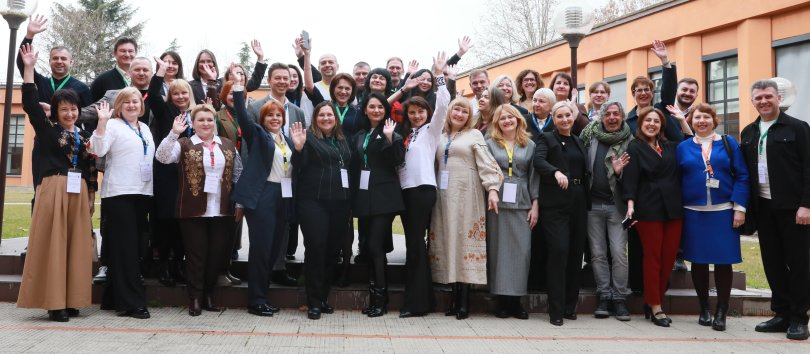
Thirty-five representatives of Ukraine’s vocational education system have gathered this week at the European Training Foundation (ETF) headquarters in Turin for a peer learning visit focused on Centres of Vocational Excellence (CoVE). The initiative, organised with the support of the Belgian development agency Enabel, aims to strengthen the capacity of Ukrainian institutions to design and implement vocational excellence models aligned with European standards.
Participants include officials from the Ministry of Education and Science, directors of vocational schools from across Ukraine, and representatives of local authorities and expert organisations involved in pilot CoVE initiatives. Over the week, they will work on governance, management, financing models and practical tools, and translate these elements into a strategic approach tailored to the Ukrainian context.
“CoVEs are growing all around the world, and the crucial part of them is the build-up of a skills ecosystem: schools, training centres, private sector, SMEs, municipalities, all involved together,” said Georgios Zisimos, Head of Policy Advice Unit at the ETF.
The visit comes at a time when Ukraine is pushing forward education reforms, including a new VET law adopted in September 2025, while also preparing for long-term reconstruction. Iwona Ganko, leading the ETF Ukraine Task Force, stressed the dual challenge: “It’s a privilege to work with Ukraine and such committed partners. Our work focuses on two priorities: supporting the EU accession path and helping the recovery and reconstruction after Russia’s war of destruction.”
“Although I have only recently started working on Ukraine, I already feel deeply connected to the country,” said Tamar Kiatishvili, ETF Country Liaison for Ukraine. “What I see is not only resilience, but immense potential for development, driven by skills and a clear European perspective.”
For the Ukrainian side, the process is part of a longer institutional journey. “We need a complete and honest understanding of our processes and to overcome the inferiority complex imposed on us in the past during foreign rule,” said Iryna Shumik, Director General of the Directorate of Professional Education at the Ministry of Education and Science of Ukraine. “I hope this week helps build a team of ambassadors of vocational excellence, not only inside the ministry but across the country.”
The collaboration has also built strong professional and personal ties over the years. “For many years, together with Iryna, we thought about how to attract international partners,” said ETF senior expert Jose Manuel Galvin Arribas. “One thing I learned from our first engagement ten years ago is that you have capacity, commitment and talent. Europe is with you, and we feel part of your family.”
A programme to support inclusive excellence
The visit is part of the BE-Relieve Ukraine programme implemented by Enabel. Under its “Education, Skills and Decent Employment” component, the programme supports selected vocational schools and training centres on their path toward inclusive excellence, following the CoVE approach. The ETF contributes with policy advice and technical expertise on vocational excellence.
Oleksandra Borodiyenko, thematic expert at the Education and Skills development Sector at Enabel, highlighted the collective nature of the effort. “The path you’re starting now is not for you alone. It’s about connection, joint projects, development and ambition. We will cross it together, learning not only from best practices, but also from mistakes and risks.”
She stressed that internationalisation and self-assessment should be tools for honest reflection rather than celebration. “Otherwise,” she added, “it becomes like old Communist party meetings where everyone is doing great and nobody sees what needs to change.”
Understanding vocational excellence and CoVEs
Centres of Vocational Excellence are increasingly used worldwide as systemic models for reforming vocational education, and are a key EU priority under the Erasmus+ programme. They. CoVEs are network organisations recognised for delivering high-quality skills and for working closely with companies, local authorities, universities and other partners to support regional economic development.
“There’s no single model of a CoVE,” explained Galvin Arribas. “It can be a single high-quality provider, a regional cluster, a network leader or a platform. But one condition is always the same: strong cooperation with the private sector and an international outlook.”
ETF’s concept of vocational excellence includes multiple dimensions: governance and funding models, quality assurance, work-based learning, teacher development, green and digital skills, career guidance, entrepreneurship, applied research and lifelong learning. Together, these elements aim to ensure that vocational education meets labour market needs and offers real opportunities for learners.
Jolien Van Uden, ETF VET Excellence coordinator, underlined the importance of adapting the model to each national context. “We are mapping centres of excellence across countries, and they never look exactly the same. The real question this week is: what should a CoVE look like in Ukraine?”
Participants are also exploring practical tools, including the ISATCOVE self-assessment tool, already piloted in regions such as Rivne and Vinnytsia. The tool helps institutions evaluate their performance across different excellence dimensions and identify priorities for improvement.
“Any self-assessment tool should be seen as an opportunity for professional growth, not as a judgement. For us, this is one of the outcomes of almost ten years of cooperation with the ETF on the road to the European Union,” said Shumik. “It feels like returning home, among friends who support Ukraine. Using the knowledge on CoVEs is extremely valuable for our reforms, as the concept is already embedded in Ukrainian law.”
Workshops during the week will also address key themes such as artificial intelligence in education, green reconstruction, entrepreneurial skills and applied research. Participants stressed the importance of “stronger links with employers”, “honest self-assessment” and “new teaching methods” as essential elements of the excellence journey.
Learning from practice in Italy and beyond, with Ukraine always in mind
In the coming days, the Ukrainian delegation will visit several Italian institutions considered examples of vocational excellence. These include the ITS Academy for Sustainable Mobility, the ENGIM training network and the Piazza dei Mestieri foundation in Turin, and the internationally recognised Cometa Formazione centre in Como.
The visits will give participants the opportunity to observe how partnerships with companies, local authorities and social actors are translated into training programmes, career guidance and innovation.
For many participants, the week is also a rare moment away from the daily pressures of war. Some spoke of the simple difference of “having electricity in the morning” or of wishing “to live without air-raid alerts”. Others focused on the future, asking how to involve the private sector more effectively, how to connect vocational and secondary education, and how reforms can support local communities.
The full-scale invasion of Ukraine will enter its fifth year next week. Fatigue is visible, but so is determination. In classrooms and workshops across the country, vocational schools have become spaces of resilience, places where reconstruction is not only discussed but prepared, skill by skill.
The participants in Turin carry that spirit with them. They speak of plans for recovery, of students who will rebuild cities and industries, and of schools that aim to become part of European networks of excellence. For many, vocational education is not just a policy field. It is one of the concrete paths through which Ukraine continues to fight for its future in Europe.
Did you like this article? If you would like to be notified when new content like this is published, subscribe to receive our email alerts.