
From Turin to Lisbon: building Ukraine's Youth Guarantee, step by step
When Ukraine's Inter-Agency Working Group on Youth Guarantee gathered in Turin in March 2025 for an intensive week of field visits and policy exchanges hosted by the European Training Foundation, the mission was clear but the road ahead was long. A year on, the same group — expanded, more experienced, and with a draft implementation plan already in hand — has reconvened in Lisbon, Portugal, for the next chapter of that journey.
The Youth Guarantee (YG) is an active labour market policy committing EU member states to ensure every young person under 30 who is not in employment, education or training (NEET) receives a quality offer of employment, education or training within four months. In place as an EU policy since 2013, it is funded through national budgets and the European Social Fund+ (ESF+).
The three-day seminar Advancing Effective Youth Guarantee Implementation Strategies (19–21 May 2026) is the latest milestone in a process that began in 2024, when Ukrainian authorities approached ETF Director Pilvi Torsti about drawing on ETF's experience with Youth Guarantee implementation in the Western Balkans. What started as a bilateral conversation has since grown into a structured knowledge-sharing programme bringing together Ukraine's government, EU member states, and international organisations, including the International Labour Organization (ILO) and UNICEF ECARO, behind a shared objective: ensuring that young Ukrainians, in wartime and beyond, have real access to employment, education and training.
"Ukraine is now into its fourth year of full-scale war of aggression, and yet we are here, working on EU accession, on labour market reforms, on social inclusion," said Torsti, joining the Lisbon opening online.
"There is a huge resilience in this country, and businesses are telling us they need skilled young people. Youth must be empowered to contribute to their society, and the forthcoming Ukraine Recovery Conference in Gdansk will be an important milestone to take this work further."
Iwona Ganko, Team Leader of the ETF's Ukraine Task Force and anchor of the programme, set the tone from the outset.
"Youth-centred policies are crucial for Ukraine's future," she said. "We are strongly focused on the recovery process, and we are doing this together with EU member states — Portugal, Slovenia, Estonia, Finland — who are here to share not just their successes, but also their challenges."
A committed family around the table
The Ukrainian delegation in Lisbon is a measure of how seriously the country is taking this agenda. Ministries of Youth and Sports, Economy, Education and Science, and Social Policy are all represented, alongside the State Employment Service, civil society organisations, and the Federation of Employers. The breadth of the group is itself a statement.
"All different sectors from Ukraine are here, demonstrating how seriously our country is committed to the Youth Guarantee," said Deputy Minister of Youth and Sports Uliana Tokarieva.
"We have already started working on the implementation plan. I have to be honest, it's a difficult job. That's precisely why it's so useful to hear from EU member states, and we greatly appreciate it. Every investment in our team finds concrete actions and decisions on our side."
Daria Andriunina, Director of the Department for International Cooperation at the State Employment Service, was equally direct about what this process means in a wider context.
"To me, the Youth Guarantee is not just about employment and apprenticeships for young people. It is about EU integration: it is our chance to demonstrate that we are capable of following that path. There will be challenges, maybe failures, but this is our future."
It is a vision that resonates beyond Ukraine's borders. The Youth Guarantee is a cornerstone of EU social policy, central to member states' own efforts to ensure no young person is left without prospects — and reinforced across the EU in 2020 as part of the post-pandemic recovery agenda.
Laura Corrado, Head of Unit for International Affairs and ETF at the European Commission's DG EMPL, confirmed the Commission's continued commitment.
"Effective implementation of the Youth Guarantee requires strong political commitment, and I can see in this room that there is strong political commitment — and that it is gaining momentum. From DG EMPL, in cooperation with the ETF, we will continue to support Ukraine on this and on all aspects of human capital development."
Scale, complexity and the stakes of getting it right
The scale of the challenge is not lost on anyone in the room. Ukraine counts close to two million young people classified as NEET, nearly 70% of them women — and that is before accounting for the estimated 1.2 million young Ukrainians who have left the country since the start of the full-scale invasion.
Bogdan Matviichuk, Director of the Employment Department at Ukraine's Ministry of Economy, was direct about what that means for the future.
"We need to think seriously about how to attract them back," he said. "They are crucial for Ukraine's economic and social growth, and these days must help us not only understand EU approaches, but test their feasibility in our own context."
That context is not a standard policy environment. Domingos Lopes, President of Portugal's Employment and Vocational Training Institute (IEFP), captured the essential logic driving the seminar: "Investing in young people is not a cost. It is a strategic investment in the future, in competitiveness, and in social cohesion."
The Portuguese experience — over a decade of Youth Guarantee implementation, built on a dense local network of employment offices and a principled approach centred on the most vulnerable — formed the seminar's keynote contribution.
Expert Paulo Feliciano, who helped design the Portuguese model, offered a candid challenge to the Ukrainian delegation:
"The scheme you are building is a good one, yet in my view the strategic and monitoring framework needs to come first. Who will coordinate outreach? Who are the service providers, and how will they work together? Who is responsible for monitoring the pathway?"
Yuliya Zhovtyak, Director of the State Employment Service, agreed without hesitation. "We do not want diluted responsibilities. It must be established very clearly."
Outreach as the front door
A recurring theme throughout the seminar was the recognition that the Youth Guarantee, as currently conceived across Europe, tends to reach young people who are already connected to services. Those furthest from the labour market — and in Ukraine, that includes war-affected youth, veterans' families, internally displaced persons, young people with disabilities, and those leaving institutional care — require something different.
Olena Sakovych, presenting UNICEF's regional analysis on outreach and wrap-around support, put it plainly. Ukraine's NEET population, she noted, is far from homogenous: family-responsibility NEETs, predominantly young women, sit alongside discouraged workers, people with health limitations, and those carrying war-related psychological distress. Each group requires tailored responses, from childcare provision to long-term confidence-building depending on individual needs.
Siria Taurelli, Senior Human Capital Development Expert at the ETF, underlined how much of the seminar's value lies precisely in the diversity of EU member state experience on offer. "Young people are the vision of the policy, not the other way around," she said.
Slovenia's approach, presented by Jana Rožac of the Employment Service, illustrated this concretely: the country approached the governance of the Youth Guarantee by embedding non-formal working groups that included youth voices from the outset, alongside employers, trade unions and NGOs. "Don't patronise us," is what young Slovenians consistently tell their counsellors.
Heidi Paabort added a data dimension, describing how early-warning systems and youth monitoring dashboards now allow Estonia to identify at-risk young people before they fall out of the system. She also stressed that an implementation plan is not a list of activities, rather a roadmap for changing how things are done (as Paabort framed it “the actions aimed at changing the actions"): by reforming and coordinating existing services and rethinking outreach approaches from the ground up, and reinforcing the chain at local level.
Jaana Kettunen from the Finnish Institute for Educational Research rounded out the picture, highlighting Finland's work on lifelong career management and the importance of removing eligibility barriers so that young people can simply walk in, without appointments or gatekeeping.
Into the field and towards Gdansk
Participants moved out of the conference room for visits to a Qualifica Centre in Setúbal and the Auto Europa Training Centre (ATEC), two examples of Portugal's integrated approach to qualification, guidance and work-based learning.
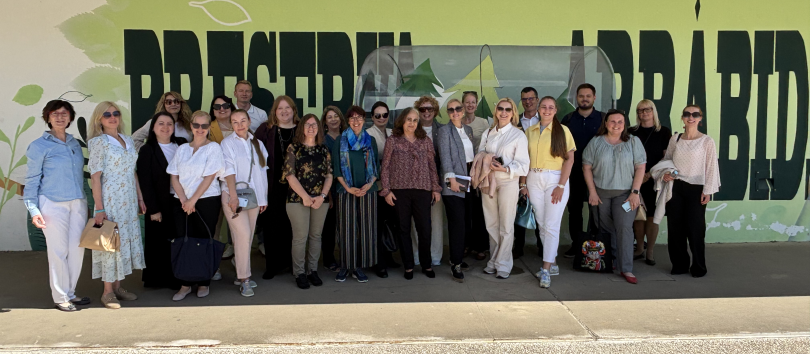
On the seminar's final day, the group travelled to Setúbal and the Arrábida area to meet the YMCA Portugal team and explore how local cooperation and youth-friendly approaches can reach young people where they are. The appetite for learning proved so strong that most participants also took up an unplanned visit to a Lisbon youth centre, a spontaneous addition to the programme that perhaps said more about the group's engagement than any formal session could.
The horizon is already visible. A Ukraine Youth Guarantee Implementation Plan is taking shape, and the next Ukraine Recovery Conference in Gdansk will offer a public milestone to present that progress.
Deputy Minister Tokarieva closed the opening day with a note that balanced ambition with a touch of humour:
"In Ukraine we say the political life of a Deputy Minister is short, and I say this with a smile. But we still need to leave concrete policies behind us, policies built on the real pathway a young person will walk through the Youth Guarantee, from outreach to opportunity."
Participants left with a sharper sense of direction: a stronger legislative basis, clearer governance architecture, more robust monitoring, and inclusive design that reaches minorities, veterans and every young person at risk of being left behind. New partnerships formed across the three days, with the ETF and its EU partners committed to staying the course alongside Ukraine on its Youth Guarantee journey.
Did you like this article? If you would like to be notified when new content like this is published, subscribe to receive our email alerts.