
Investing in skills: World Refugee Day
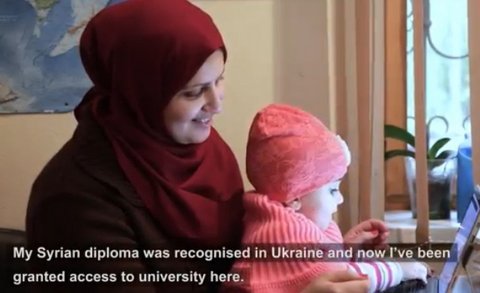
Meet Marva from Syria, a dental technician updating her skills to find a similar job in Kyiv, Ukraine and Slava from Belarus, a lift installer in Helsinki, Finland. What do they share in common? They are both young migrants benefiting from inclusive systems that recognise their skills and offer access to further training.
Watch Marva's story here and Slava's story here.
Investing in skills in a world in transition
Editorial from the June Issue of Live&Learn here.
The world is on the move – and so are people. Migration towards the EU and its neighbouring countries is one of the factors reshaping the societies we live in and affecting our concepts of work. Whatever our journey, we all move with one valuable currency in our luggage: our skills. Recognising and rewarding skills is a long-term investment for origin and destination countries as well as for migrants to ensure inclusive growth that benefits everyone.
When people move, taking risks and facing change become daily needs. In this context, being able to rely on one’s professional or personal skills is a precondition for a new start. Slava and Marva have benefitted from inclusive systems that recognised their prior skills, gave them access to further training and prepared them for the needs of their new societies. Their story is the story of thousands of people on the move across borders.
Skills are valuable tools, and yet data show that they are underused. The EU’s 2020 Entrepreneurship Action Plan (2013-2020) highlighted that migrants’ skills are under-exploited in the EU labour market, and that migrants are under-represented within the entrepreneurial population. Yet in many secotors in the EU, labour demand exceeds available supply: it is in the common interest to open more paths to leverage the potential for creative and new solution linked to cross-border migration.
In the first instance, formal mechanismis are needed to grant recognition - or partial recognition - to skills obtained through formal education. Use of skills should be enabled through access to necessary complementary courses related to local job market requirements, including language. In parallel, skills acquired through informal learning should be validated by authorised bodies in line with relevant standards.
Secondly, skills offered should to be matched to skills needed, in order to maximise employability. Data collection is key to this, and policy makers need to track qualifications and monitor success rates on the labour market to strengthen counselling services and adapt policies. Finally, strategies should be developed to facilitate the socio-economic integration of third-country nationals in host communities, to maximise the economic potential of migrants to the economy.
The EU is fully committed to this process: it supports skills assessment and access to training through the EU Action Plan on the Integration of Immigrants in the EU; it assists Member States to verify qualifications of new arrivals through the Skills Profile Tool for non-EU nationals; and it facilitates socio-economic inclusion through the EU’s 2020 Entrepreneurship Action Plan. The EU is working with neighbouring countries to boost domestic job markets and strengthen the vocational training and education systems.
As the only EU agency active in the area of external relations through education, at the European Training Foundation we are fully committed to make this happen. In almost 30 countries – from Belarus, to Azerbaijan, to Tunisia – the ETF provides advice and guidance to enable validation and recognition of skills, in line with best practice in the EU.
In all its partner countries, the ETF promotes the development of occupational standards, to ensure that a functioning comparative system is set up. We ensure that the validating authorities are qualified, since their reputation has an impact on the employability of job-seekers. Moreover, by means of better vocational education policies, we support citizens’ access to the labour market. Throughout all its activities, the ETF promotes cooperative approaches, supporting domestic reform efforts at national and regional level.
The EU and its neighbours are closely interconnected, and current trends will intensify this proximity. Economic growth and stability are common goods for the EU and its neighbours, requiring close cooperation and a shared vision also in the area of education and training. Skills are in everyone’s backpack. In this world on the move, it is in our common interest to make these skills more visible, understandable and portable.
World Refugee Day
World Refugee Day, held every year on June 20th, is an opportunity to commemorate the strength, courage and perseverance of millions of refugees.
More info: http://www.un.org/en/events/refug eeday/
Did you like this article? If you would like to be notified when new content like this is published, subscribe to receive our email alerts.