
Building future-proof qualifications in Central Asia: DARYA seminar brings Europe and the region even closer
From 2 to 4 December in Turin, more than fifty representatives from Central Asian institutions, international experts and European partners gathered for the seminar on regional and national approaches to occupational and qualifications standards in Central Asia, under the EU-funded DARYA project implemented by the European Training Foundation.
Hosted at Toolbox Torino, the event marked an important milestone in DARYA Thematic Module 2, which promotes stakeholder-driven, flexible and permeable approaches to qualifications. As countries across Central Asia move from input-based systems to competence-based learning, assessment and recognition, the seminar offered a much-needed shared platform to compare national developments, test methodologies and explore how qualification systems can better respond to current and emerging labour-market needs.
At the heart of DARYA’s Module 2 lies the ambition to strengthen qualifications design, develop multicountry occupational profiles relevant for the countries and for the EU’s Global Gateway investment priorities in the region, improve interoperability and support lifelong learning, including the validation of non-formal and informal learning (VNFIL). These themes framed the agenda across all three days.
A core focus of the seminar was the presentation of results from the DARYA pilot on multicountry occupational profiles. Six profiles have been jointly developed by Kazakhstan, Kyrgyzstan, Tajikistan and Uzbekistan in: tourism (guide), construction (surface finisher), transport and logistics (truck driver, warehouse operator), housing and utilities management (energy efficiency auditor), and e-commerce (marketplace specialist).
These profiles set out shared competence requirements across countries and now serve as a basis for updating national occupational standards, curricula and future qualifications reforms.
“Multicountry occupational profiles give us a common language and a regional core,” noted Vassilii Bezrodnov from Skillproof in Kazakhstan. “They help countries compare standards and prepare the ground for regional recognition.”
Nadezda Solodjankina, human capital development expert and DARYA Module 2 Coordinator at ETF, opened the seminar by underscoring the strategic relevance of the pilot for capturing and describing the labour market requirements in the regional sectoral context.
Participants also reflected on methodological lessons. Tajik and Kazakh representatives emphasised the need for unified normative approaches, while experts highlighted the flexibility the pilot offered in piloting some new methodological approaches. “We had the freedom to build a full professional profile,” said a participant from Uzbekistan. “This is exactly the kind of capacity we need to strengthen.” Several delegates stressed that the establishment of a regional qualification centre would be valuable given high levels of labour mobility in Central Asia.
The seminar also zoomed in on the European Skills, Competences, Qualifications and Occupations (ESCO) classification. Laura Veza-Visan, human capital development expert at the ETF, presented the structure and potential of ESCO, which includes approximately 3,000 occupations and 14,000 skills. She explained how AI-assisted methods are now used to maintain and expand ESCO. “Machine learning helps us make ESCO more efficient and easier to use,” she noted.
Interest from Central Asian countries was high, particularly regarding ESCO information sources and ESCO update cycles and the use of ESCO for updating and developing qualifications.
Anatolii Garmash, Senior ETF expert on qualifications, highlighted its strategic significance: “When countries compare their national qualification standards with ESCO, they gain a tool to shape new standards aligned with future skills.”
Garmash also stressed the importance of presenting qualification information in a language accessible to employers and international investors, as well as the relevance of this work for EU candidate countries such as Moldova and Ukraine, which can offer useful examples to Central Asia even if their integration objectives with the EU are different.
Peer learning with Italy and France: lessons from the field
On the first day, participants were also introduced to Arduino, an open-source hardware and software platform created in Ivrea, in the Piedmont region, widely used in education, prototyping and digital innovation. The presentation showed how simple, low-cost microcontroller boards can help connect schools, training centres and the labour market by bringing practical electronics and coding into classrooms and workshops.
Referring to long-standing cooperation between the Polytechnic University of Turin and the University of Tashkent, Abduagzam Jalilov, from the National Qualification System Development Institute in Uzbekistan, pointed out that Uzbek students have been working with Arduino for years and expressed the hope that “one day we will host an Arduino Day in Tashkent”.
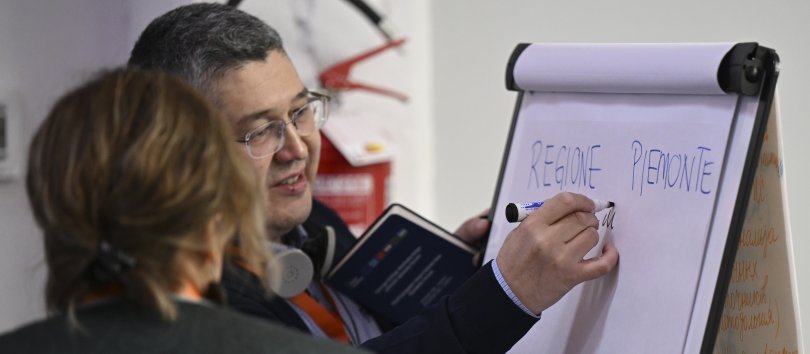
A distinctive feature of the event was the second-day site visits to regional authorities in Piedmont and to Formont, a vocational training and VNFIL provider. This provided a practical opportunity for participants to observe governance structures, the formulation of standards and the implementation of validation services.
Formont trainers illustrated Italy’s increasingly people-centred approach to VNFIL. “We support individuals to understand the skills they already have and those required by the labour market,” said Erica Veronese. She explained the combined use of certification experts and field specialists throughout the process, highlighting the EU-funded nature of the service and its accessibility.
French representatives offered insights into the governance of qualifications and the registration process in the RNCP (Répertoire National des Certifications Professionnelles). Elena Altukhova of France Compétences stressed that one of the primary goals of the system of national qualifications is to satisfy socio-economic needs. The system allows for flexibility when needs for new qualifications arise. At the same time, it secures quality through applying quality criteria for registration of qualifications in the registry. Qualiopi quality certification is also implemented by training providers seeking access to public funding.
Kassim Bouhou and Renaud Richard of AFPA (Agence nationale pour la formation professionnelle des adultes) stressed the role of labour-market foresight: “Qualifications must be designed with and for the labour market. It is also a matter of dignity for workers everywhere. Countries need structures that allow employers, experts and authorities to work together on long-term visions.”
The afternoon sessions further explored Italy’s Atlante del Lavoro e delle Qualificazioni, with INAPP (Istituto Nazionale per l'Analisi delle Politiche Pubbliche) experts presenting how occupational maps, standards and curricula are integrated within a national and regional system.
Sharing country practices and preparing next steps
The final day focused on reflections from Central Asian countries engaged in the pilot on national qualifications. Representatives from all five countries noted progress in designing qualification standards, embedding learning outcomes and strengthening multistakeholder cooperation. Digitalisation emerged as a shared priority, with Kazakhstan and Uzbekistan sharing experience in implementation of digital platforms for professional standards and skills catalogues.
From Kyrgyzstan, Svetlana Sirmbard underlined both progress and challenges: “We clearly need to continue working on the methodology for multicountry occupational profiles. At the same time, we have not yet used all the opportunities that DARYA offers. At the national level we must build a stronger internal structure for cooperation between experts, employers and public authorities.”
“All Central Asian countries are moving in the right direction, even if the path is long,” said Olav Aarna, DARYA international expert.
Regional experts acknowledged inspiration drawn from European partners. “Thanks to the opportunities provided by DARYA, we saw in Italy and France what highly qualified teachers and assessors look like,” said a Turkmen participant.
In her closing remarks, Nadezda Solodjankina outlined steps for the first half of 2026. The plan includes piloting validation of non-formal and informal learning across all five countries, developing assessment standards, strengthening assessor training, and organising two peer-learning visits to Ireland and Sweden.
Vidmantas Tūtlys, DARYA international expert, summarised the lessons learned: “The next phase must focus on strengthening expert groups across countries and refining the methodology for occupational profiles. These two elements are key for sustainable work.”
As Central Asian countries continue modernising their qualifications systems, the Turin seminar showed how shared tools, common methodologies and concrete peer learning can translate into very practical next steps.
By bringing together regional institutions, labour-market actors and experts from Europe and Central Asia, DARYA Module 2 is helping to build qualifications frameworks that are more transparent, comparable and responsive to the evolving labour market needs – and ultimately better able to support mobility, decent work and long-term development across the region.
Did you like this article? If you would like to be notified when new content like this is published, subscribe to receive our email alerts.