
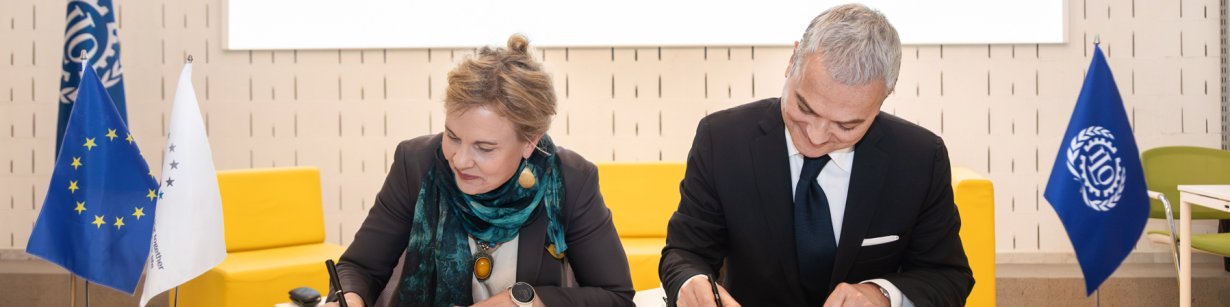
"Another bridge across the Po": ETF and ITCILO deepen long-standing collaboration
The European Training Foundation (ETF) and the International Training Centre of the ILO (ITCILO) have a long‑standing history of cooperation. Their offices sit on opposite sides of the city, but their mandates intersect, and their work often addresses similar questions: how people learn, how skills evolve, and how education and training systems can respond to labour market change.
A new cooperation agreement between the two organisations formalises this relationship for the next five years. Rather than introducing something entirely new, it provides a clearer framework for current projects, and for work that can now be planned more deliberately.
What’s more, by moving from ad hoc cooperation to a structured, long-term framework, the ETF and ITCILO are setting an example of how international actors can pool expertise, align priorities and increase impact locally and internationally.
From shared space to shared work
"The agreement with the ITCILO strengthens an already solid collaboration and shows how Turin can play a central role in the global debate on skills and the future of work. Together, we aim to build on existing synergies and contribute to concrete solutions with impact at both international and local levels."
Learning as a shared space
Together, the ETF and ITCILO can connect policy design with learning practice, and strategic vision with on‑the‑ground implementation.
The cooperation has a particular focus on:
skills development and lifelong learning;
career guidance and transitions in the labour market;
digital education and inclusive learning;
forward‑looking approaches to the future of education and work.
One area where collaboration has already taken shape is learning and knowledge development. The ETF and ITCILO have jointly worked on training modules, learning materials and publications that explore how education and training systems are changing.
These include the co‑development of training materials and learning offers, joint work on digital inclusion and innovative pedagogy, and shared knowledge products such as "Learning in Motion. Navigating the Next Frontier", presented during the signing event.
The organisations have also worked together through collaborative learning initiatives, such as the "Unveiling the Colours of the Economy" event, which brings policymakers, experts and practitioners together to explore emerging skills needs in a collaborative setting.
These are not standalone activities, but part of an ongoing exchange between policy analysis and learning design, by testing concepts, adapting them to different contexts and feeding lessons back into broader discussions on skills.
This cooperation allows the two organisations to respond more effectively to the needs of the countries they work with, while reinforcing shared international frameworks such as the Sustainable Development Goals, the European Consensus on Development and the EU’s Union of Skills agenda, and to reach wider audiences through shared platforms.
Anchored in Turin, connected internationally
The partnership also reflects how international organisations can work locally without becoming locally focused. By anchoring part of their collaboration in Turin, the ETF and ITCILO use the city as a place to convene, experiment and connect, but the work itself remains international in reach.
"This partnership is a platform, not a destination. We are committed to building Turin into a genuine, deliberately governed International Skills Lab, where locally rooted collaboration can generate global impact."
This approach also aligns with other recent efforts by the ETF to strengthen ties with the local ecosystem, including collaboration with the University of Turin and participation in local education and employment initiatives.
Looking ahead toward continued collaboration
The five‑year horizon of the agreement reflects the understanding that transforming skills systems, and responding to the evolving nature of work, requires sustained effort and institutional commitment.
Looking forward, the ETF and ITCILO will continue to use their partnership to support countries they work with, contribute to international policy debates and foster innovation in learning and training. An early sign of this ambition is the upcoming Torino Global Skills Summit (23–25 November 2026), which will bring together policymakers, social partners, international organisations, researchers and practitioners to reflect on how skills systems can remain competitive, resilient and inclusive.
Did you like this article? If you would like to be notified when new content like this is published, subscribe to receive our email alerts.