
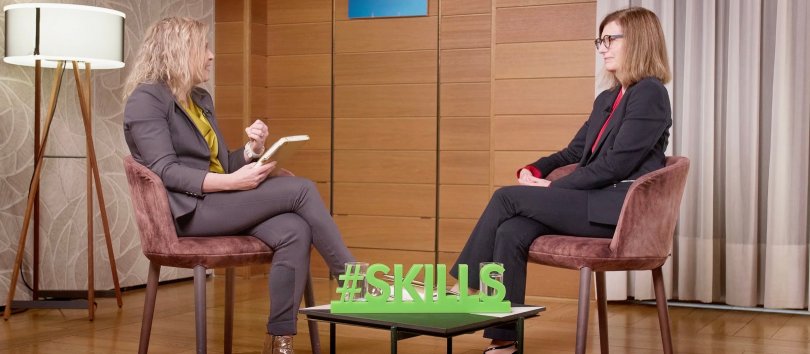
In Conversation with Pilvi Torsti: Manuela Geleng on skills, mobility and Europe’s future workforce
In this episode of In Conversation with Pilvi Torsti, Pilvi Torsti, Director of the ETF, welcomes Manuela Geleng, Director for Jobs and Skills in the European Commission (DG EMPL). With decades of experience on the future of work, youth employment, vocational education and training, and skills policy, she offers an in‑depth look at Europe’s skills agenda at a time of profound transformation.
Understanding Europe’s Skills Challenge
PT: Manuela, I would like to really start about the very broad overview that you can have taking the times we live in. We really see that the skills need have changed in the labour market.
Nearly three‑quarters of employees report actually difficulties in finding workers with the right skills. So, as the Director for Jobs and Skills, how do you describe the role of your Directorate of the EU in addressing this “skills problem”?
MG: I think the issue of skills, the need for better skills, for having the right skills that are needed in the labour market has been a problem for quite some time now. But I think we are coming to a point where the urgency is creating the need for a step change, because the transformation is going faster and faster.
And we have a smaller pool of people that can actually deliver that transformation.
And there is where we need to become much more active.
And when I say we, it’s not just at European level, at national, at local level, companies, social partners, we all have to engage in a much more proactive way.
Are We Coming Together? A Renewed Awareness Across Europe
PT: Given the urgency, are we coming together: EU, Member States, cities, employers?
MG: I think there is a renewed awareness that we need to come together, and we don’t start from scratch. We have some initiatives at European level that have really managed to gather, to join forces, for instance, the Pact for Skills, where companies, social partners, public authorities, employment services come together to upskill and reskill the workforce.
This is one example.
The most recent example, more at policy framework level, is the Union of Skills, which has a key objective to join the dots between employment and education.
We cannot solve the skills problem only by working on education or only by working on employment.
It will work only if we work together.
How the Union of Skills Can Reshape Europe’s Training Ecosystem
PT: Given that you have worked now to develop the Union of Skills, how do you think it can shape Europe’s training systems and really support workers to move into better jobs, to new jobs?
MG: Well, I think there are four areas of work within the Union of Skills.
First area: to make sure that our young talent gets the best education and training so that when they join the labour market, they have the skills that are really needed.
But we also put the focus with the Union of Skills on the upskilling and re‑skilling of the labour force. And this is really important — changing the mindset that you haven't just learned at school, but you will learn throughout life and you will do so, actually.
But also, in taking away the barriers that we have now. We have a single market, but we don’t have a single market for skills, so people that want to move from one country to another or want to join Europe with their qualifications and their skills have problems.
And this is what also we would like to look at more in detail.
So, looking both at young and adults in the framework of the Union of Skills is really the kind of grand idea of the EU in this policy. It focuses on how we can give to young people the best skills we can so that they can master their lives, their working lives, and that means they have to learn to learn.
And adults: we want to entice them to upskill and reskill throughout life, to give them the means to do so and the understanding of how important it is that they upskill and reskill if they want to continue having a job and a quality job.
Adult Learning: Reaching the 60% Participation Target
PT: There is a target for 60% attendance, while the current average is around 40%, and in many countries within the Member States much less. How can the approach inspire countries also now beyond the EU, and what support can EU offer so that low-skilled mid‑career people could participate more in adult learning activities?
MG: We have a target that every adult should participate at least once a year in training, and by 2030, 60% should do so. The reality varies widely between Member States. Some reach the target, others are far behind.
That’s why Member States have also set their own national targets on how to make progress.
At the European level, I think we have really put in the last few years the focus on adult learning.
We have launched a number of initiatives like the Pact for Skills that I mentioned.
We want now the Alliance for Apprenticeships, whereby companies and other organisations pledge apprenticeship places — to extend it to adults as well.
We will be launching as part of the Union of Skills a Skills Guarantee that is helping adults to move from sectors that are in decline to sectors that are in demand.
But of course funding is limited at all levels. So we really need to make the best of it, and we need also companies to join in — the private sector — to join in this initiative in supporting the development of skills of their workforce or the workforce of their value chain.
I think we need to think in a broader perspective as well because we are all in the same boat, right?
Fair Mobility and the Global VET Agenda
PT: So having now covered Union of Skills, Pact for Skills, these initiatives — moving to the mobility and global VET agenda. Of course, again, interrelated, yet also very prominent in your portfolio. Last September, we had the Vice President Minzatu reminding us, and I quote:
“Labour mobility must be fair, and when a worker moves, their rights should move with them.”
Manuela, how do you see — how can EU strengthen the recognition and really ensure this type of fair mobility for all, so that there is a kind of triple win:
Win for the worker, win for the receiving country or region, and win for the country of origin in economic terms, but also on a personal level?
MG: I think skills and qualifications are not yet portable across Europe. Sometimes they are, sometimes they are not. And I think one of the initiatives we will be launching under the Union of Skills is precisely about skills portability. We will be looking at how we can make it easier for workers to move across borders with the skills and the qualifications, tackling the barriers that they encounter. We will also be looking at how we can modernise the system of regulated professions that we have.
As you know, some professions are regulated at national or European level. And we will be looking at how we can facilitate that.
Thirdly, we will also be looking at how we can facilitate people from third countries moving into the EU with their skills and qualifications.
So, I think we should have rather a skills‑based approach: If the person has the right skills for that job, they should be able to take up that job.
Another issue is clearly if this is a regulated profession, like doctors, nurses, lawyers — then specific rules are in place. But for the bulk of jobs in the single market, there is actually no need to have a recognition of your qualifications, you should just be able to take up the job.
PT: So, what hinders employers to take someone?
MG: I think it's the trust in the qualification that has been acquired in another Member State.
And that I think is really a hurdle. And for that we have a number of tools at European level that enhance the trust and the transparency of the qualifications. That’s one thing we recognise in many countries where ETF works, so you have on one side the qualifications and their portability, and on the other side the recognition of skills.
PT: And of course, the importance of working on both, in some cases, it's really important that you have the qualification element recognised and worked with the European standards.
MG: Yes, I think the story is a bit different for third countries because there, what we can do at European level is to look at how we can facilitate and streamline the procedures to apply with your qualification and skills.
Because all the rest which concerns visas remains a national competence.
But even there, we see how complex it is for someone from a third country applying to the EU — they have to come up with different documents for different countries.
Procedures take a very long time. And many third‑country nationals that work in Europe work below their qualification level. And I think this is really a loss of potential for people, and we should avoid that — particularly in a situation where we are struggling to find the right skills in our labour market.
Why Cooperation Beyond the EU Matters
PT: Regarding the role of ETF and now the external use, external enlargement: How important is it for EU citizens and Member States to actually have access and work together with the outside world?
MG: I think it's fundamental because we all live in the same world and we live quite closely together, and we really need to make sure that we understand each other.
And I think for some countries which will be one day a member of the EU, it’s even more important to have an understanding of how the European system works.
And many of the challenges we see — we are all faced with digital transformation, we are faced with decarbonisation — why not face these challenges together?
When we then look at the next budget, which we are working on at EU level now, there is growing attention on investment and stronger ties with countries outside the Union, in particular in the priority economic sectors that have been analysed by the European Union.
PT: How do you see the skills investment here? Should they really be part of the design, a priority when the EU looks at investments, third countries and regions, and should there be some formal mechanisms for that?
MG: Well, I think skills are a fundamental aspect, right? And we are working within the Commission to have this skills aspect always present. And I think if we come forward next year, for instance, with a strategy on vocational education and training, it will have an international dimension. This is important because we need to interact with our neighbours, with our partner countries — and before we were speaking about an international dimension, but now it's really high on our agenda.
A Question from the Previous Guest: Europe in 2050
Each guest receives a question from the previous episode. This time, it comes from Arthur Erken, Regional Director for Europe and Central Asia at IOM:
“By 2050, how will Europe have transformed itself to stay a powerful continent economically, politically and socially?”
MG: I can only answer with what would be my wish.
I think:
A fully carbon‑neutral Europe
A Europe that has managed the digital transformation, where the human being is still at the centre and is not driven by AI but decides
A Europe that lives in peace and prosperity and is bigger and stronger
A Europe that lives in peace and prosperity with our neighbours, near and far away
PT: As a last question, I come back to the Union of Skills.
I was told some weeks ago that in this complex world where we have a lot of strategies and so on, sometimes we have the risk to get lost, that everything seems so difficult.
For you, what seems at the moment the most critical, important next step in bringing the Union of Skills forward as a policy?
MG: Cooperation. Because I think what is missing is a lot of energy out there, a lot of goodwill — but everybody tries to do it in their little corner.
And I think we can be much stronger and much more efficient if we work together.
And that’s what the Union of Skills is about: joining forces, particularly between the labour market and the educational world.
Did you like this article? If you would like to be notified when new content like this is published, subscribe to receive our email alerts.