
What to do when policies lag behind? AI, skills and the future of work discussed as ETF releases its new report
AI is reshaping society at a speed that institutions, by their very nature, struggle to match. Regulations arrive late, training systems adapt slowly, and policymakers are left navigating a landscape that changes faster than any framework can capture. So what should governments, educators and workers actually do?
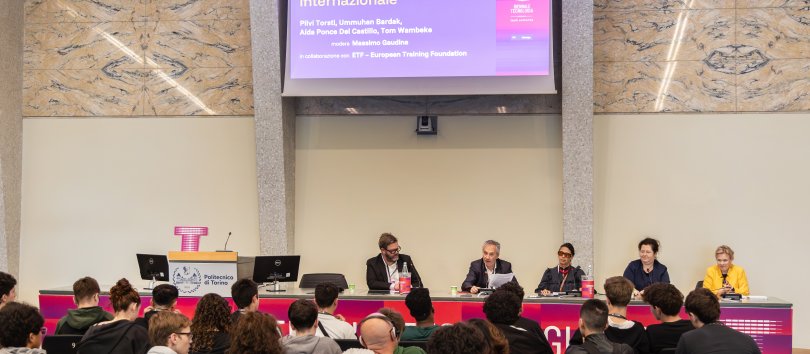
That was the question at the heart of a panel organised on 17 April by the European Training Foundation (ETF) at the prestigious Biennale Tecnologia hosted at the Polytechnic University of Turin, where four international experts gathered to discuss the findings of ETF's newly published report, The Impact of AI on Labour Markets, and what it means for workers, educators and policymakers worldwide.
The panel, moderated by ETF's Special Advisor to the Director Massimo Gaudina, brought together voices from across the European and international landscape. As Gaudina put it in his closing remarks: "No single country alone can stand these challenges."
ETF Director Pilvi Torsti opened with a provocation, asking the audience how many had used AI for their work that week and how many had felt proud of something they or their colleagues had achieved. She set the tone for a conversation as much about human agency as about technological change. "In my lifetime," she said, "we haven't seen such a disruption. The last one of this kind was probably the Industrial Revolution."
That scale, she argued, is precisely why understanding AI's impact across different social groups and working conditions is so urgent. Central to the discussion was the report itself, curated by Ummuhan Bardak, which challenges a prevailing narrative: we are probably overstating the disappearance of jobs, while too little attention is paid to which sectors are being disrupted, and who is benefiting — and who is not.
Algorithmic management is one of the least visible yet most consequential dimensions of this shift. Still poorly understood by the wider public, it is spreading fast: from the gig economy into offices, hospitals and now classrooms. Aída Ponce Del Castillo, researcher at the European Trade Union Institute, put it plainly: "It was prominent in platform work, in delivery sectors like Uber and Glovo, but now it is being exported to other sectors, including teaching."
The growing AdTech market in education — tools that help plan curricula, evaluate students and personalise learning pathways — is expanding rapidly across primary, secondary and university levels alike. The key question, she argued, is governance: what risk assessments are being conducted before these tools enter schools, and who is assessing the risks of surveillance and the erosion of professional autonomy?
Tom Wambeke, Chief of Learning Innovation at ITCILO, offered perhaps the most expansive frame of the morning.
"A few years ago at the Biennale, we had Nassim Taleb talking about his famous Black Swan [the idea behind Taleb’s book that rare, high-impact events rewrite the rules entirely, ed.], and AI is indeed a black swan. But we are also living through what Nadia Zhexembayeva calls a metaruption: AI, geopolitics, demography, the green transition, all reinforcing each other simultaneously."
AI, he argued, is not just different in kind from previous technologies but in speed and exponentiality. During a visit to the quantum computer at the same Polytechnic, Wambeke was “reminded that AI does not stand alone”: robotics, quantum computing and other converging technologies are part of the same paradigm shift. And paradigm shifts, he added, require strategy shifts too, starting from how organisations recruit, retrain and manage their own people.
Cristina Mereuta, head of the ETF's Skills and Jobs Knowledge Hub, brought the stakes home with a personal note.
"I come from an engineering family," she said, "and my sons are struggling right now, after graduating in these fields, to enter the labour market."
AI has already heavily impacted entry-level jobs, particularly in research, finance and translation, and the effects will likely become more visible within one to two years. Her message to the secondary school students in the room was direct: career guidance services are essential and must be publicly supported. There is already a "radical need for prioritisation of human workers," she said, alongside clear incentives for juniors and newcomers in the labour market.
The audience pushed the conversation further. Students, researchers and practitioners asked about AI's role in political and info campaigns, the geopolitical risks of European dependence on American BigTech — slowly being addressed through the Commission's investments — and the strikingly different national approaches to digital education and AI regulation, with the EU being at the forefront. The underlying anxiety was the same throughout: can international frameworks ever keep pace?
The answer, repeated in different forms by all four speakers, was the same: it depends on choices. Policy choices. Governance choices. Ethical choices. The ETF's role is to provide the evidence base and the frameworks that help countries — from EU member states to Ukraine, Palestine, Lebanon and beyond — make those policymaking decisions wisely. The report is out, while the AI disruption is already reshaping lives, careers and classrooms. What comes next is a collective decision, one that will define how work, learning and opportunity are distributed across the twenty-first century.
Did you like this article? If you would like to be notified when new content like this is published, subscribe to receive our email alerts.