
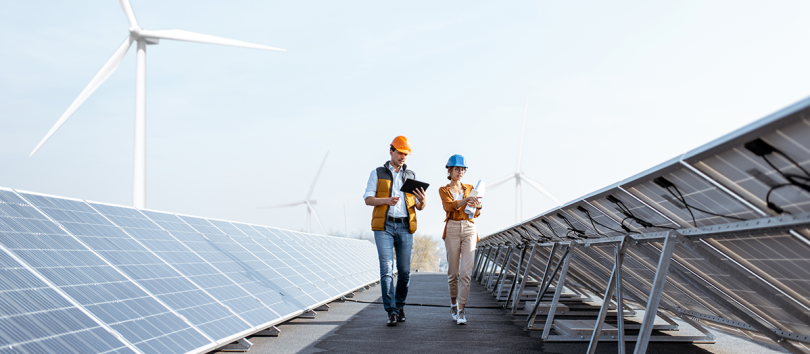
Energy transition in Montenegro: addressing skills, technologies and emerging bottlenecks
Montenegro’s energy sector is entering a period of accelerated change. As regulatory alignment with the European Union advances, investment in renewable energy is increasing alongside heightened attention to energy security. These developments are unfolding in parallel with technological shifts that are changing how energy systems operate on a day‑to‑day basis.
For a small economy where most technologies are introduced from outside, this raises a practical question. How quickly can education and training providers, employers, and public institutions adapt to new technical demands in energy production, system operation, and equipment maintenance?
An upcoming analytical report by the European Training Foundation, carried out in support of Montenegro’s smart specialisation process, will engage directly with this question. Drawing on this work, lessons emerge on how skills, technology adoption and implementation capacity interact in support of Montenegro's energy sector.
Energy policy now carries economic consequences
Energy policy across Europe has taken on a different weight in recent years. Concerns that once sat largely within technical or environmental debates are now closely linked to economic resilience and public finances. Renewable energy expansion continues, but it brings new operational requirements and tighter interdependencies across systems.
For Montenegro, renewable energy offers a route towards greater autonomy, yet it also increases reliance on skills that are not evenly available across the labour market. Where capacity is missing, implementation slows and external support becomes the default option rather than a temporary measure.
Existing assets do not guarantee readiness
Montenegro enters this phase of the energy transition with established assets. Hydropower infrastructure has shaped the electricity system for decades and continues to provide stability. Solar and wind energy have expanded more recently, supported by new investment models and a growing project pipeline.
At the same time, readiness varies across technologies. Solutions that are becoming central to energy systems elsewhere, such as battery storage or advanced digital tools for system management, remain less developed domestically.
This does not reflect an absence of strategic intent. Rather, it reflects the pace at which infrastructure, institutional capacity and skills can realistically evolve. In such a setting, technology choices and workforce capacity become closely intertwined.
Technology adoption is moving faster than skills adaptation
Global innovation in the energy sector has followed a long upward trajectory. Over several decades, development has concentrated increasingly on storage, system flexibility and digital control. For countries that largely adopt rather than design these technologies, the main question is whether the workforce has the skills needed to put them to work.
Technologies that mature quickly tend to reshape occupational roles. As tasks change, workers need to interact with new tools, data systems, and equipment. Maintenance becomes more data‑driven, and routine technical roles may require stronger digital and problem-solving skills. If education, training, and workplace learning respond slowly, adoption may remain superficial, andexpertise may stay concentrated outside the domestic workforce.
The ETF’s analysis combines global technology trends with national readiness assessments and stakeholder input to explore where these pressures are likely to emerge in Montenegro. The picture that develops is uneven, with some areas well supported and others lagging the pace of change.
Delivery constraints emerge first at technician level
Across energy systems, technicians and operators play a decisive role. They install equipment, keep systems running and respond when failures occur. As renewable deployment accelerates, these functions become more demanding, not less.
In Montenegro, vocational and adult learning pathways do not yet generate sufficient numbers of technicians with up‑to‑date practical experience in energy technologies. Training provision is fragmented, while exposure to modern equipment is inconsistent, and opportunities for structured upskilling are still limited. Companies compensate through outsourcing or by relying on a small pool of experienced staff.
Over time, this limits learning and slows the accumulation of skills in the domestic labour market.
Digital investment depends on everyday operational skill
Digital tools are increasingly embedded in energy operations. Simulation software, monitoring platforms and automated control systems are now standard components of modern networks. Their effectiveness depends on how well they are understood and used at operational level.
This does not concern specialised engineers alone. Technical staff are increasingly expected to work with digital interfaces and interpret system data accordingly. Where these competences are weak, the benefits of digital investment remain partial.
Addressing this gap requires changes across education and training, including vocational programmes and short courses for workers already in employment. Progress in this area tends to be incremental, shaped by institutional capacity as much as by policy ambition.
Skills capacity shapes strategic choices in the energy sector
Smart specialisation relies on selective focus. Rather than pursuing all possible technology pathways, it concentrates resources where economic potential and implementation capacity can reinforce each other.
In the energy sector, this places skills development at the centre of strategic choice. Evidence from Montenegro suggests that renewable generation, storage, digital system management and energy efficiency are areas where workforce capacity will shape outcomes directly. Skills shortages may delay projects, but just as importantly, they influence which technologies are taken forward.
For this reason, skills considerations cannot be treated as a secondary concern. They should influence investment decisions and regulatory design, and determine how strategies translate into practice.
Managing the gap between ambition and capacity is a long‑term task
Montenegro’s energy transition is advancing, but its direction will depend on how technologies and skills develop together. Evidence will continue to evolve, and further analysis will inform policy choices as the smart specialisation process moves forward.
What is already apparent is the time lag between technological ambition and workforce adaptation. Technologies can be introduced relatively quickly. Skills systems change more slowly, shaped by institutions, incentives and long‑term investment. Managing that gap remains one of the central challenges for the energy sector.
Did you like this article? If you would like to be notified when new content like this is published, subscribe to receive our email alerts.