Understanding system change through the Torino Process
 People need lifelong and life-wide learning for prosperous careers, lives and societies. This requires responsive and adaptive education and training systems.
The ETF’s Torino Process undertakes monitoring of system performance and adaptation every two years in the EU’s neighbouring regions through regular data collection and policy review based on a comprehensive monitoring framework.
As well as being an opportunity and tool for all stakeholders to engage in a country’s reform efforts, the Torino Process results indicate how systems are progressing on various dimensions, and responding to skills gaps and needs, including those for the green and digital transitions. The results help the ETF to better tailor country activities and policy guidance, and input to EU external relations programming.
The ETF’s Hugues Moussy, Head of Systems Performance and Assessment Unit, gives insight into the key features of a system level approach and how the ETF's Torino Process is capturing developments in the EU’s neighbouring regions.
Why is it important to look at education and training from a systems perspective?
This systemic approach is important to view multiple levels and components which interact and contribute to a successful system, for example, the policy objectives, resources and priorities of the national system, international cooperation, public and private investment, and collection and good use of data.
There are two purposes to using a systemic approach to education and training, including vocational education and training. The first is to consider how it performs in terms of delivering results to its stakeholders, and secondly, how policies impacting on the system alter its performance and where improvements can be made.
What does a successful education and training system look like?
It should have both ‘internal and external efficiency’, which put simply, means to have a certain level of quality in how it works internally, equal access, equity in the learning offer, ensuring that curricula are relevant, as with green and digital skills, and that teachers are suitably trained and up to date on sectoral developments so that learners can benefit. Working well externally means that learners are equipped with the skills they need to actively engage in the labour market, but also to become critical and responsible citizens.
How does the Torino Process help?
The Torino Process is an instrument that has been developed for more than a decade by a collective of dedicated and talented experts in the ETF to enable system development in partner countries in the EU’s neighbouring regions.
With the Torino Process, the ETF has produced a vision of a system that can be adapted to different contexts and national objectives, which highlights what is needed to perform well, how shortcomings can be resolved, and challenges can be met. This is important especially as too often instances of good practice remain isolated and fail to create benefit at system level with a loss of time, resources, and opportunity.
What is the Torino Process monitoring framework?
The latest revision of the monitoring framework has two levels. At the first level it aggregates and analyses quantitative data, using system performance indicators, from many different sources that exist at international levels. This level looks at the performance of the system and is complemented by a second level which involves a policy review to understand better and help explain the results of the system and how the system delivers. The overall purpose is to ensure a targeted, and demand-driven process of collecting, identifying, and interpreting information for policy purposes.
The analysis of both levels is used to inform an overview of the system that is divided into eight dimensions representing the areas of ‘access, quality of outcomes and system organisation’.
How do ETF activities relate to a country’s overall education and training system?
The ETF’s various projects and activities all relate to one or more areas and dimensions, whether it is developing curricula for green and digital competences, focusing on innovation in vocational education, supporting governance, or knowledge sharing on active labour market measures for youth. Indeed, a lot of policy discussions on education and training concern the interaction of these components. For instance, the development of green and digital skills is an issue of relevance to the labour market to ensure quality, but also of access especially for marginalised communities so that they can also benefit from the employment opportunities of the green and digital transitions.
What is the added value of the Torino Process compared to other monitoring frameworks in education and training?
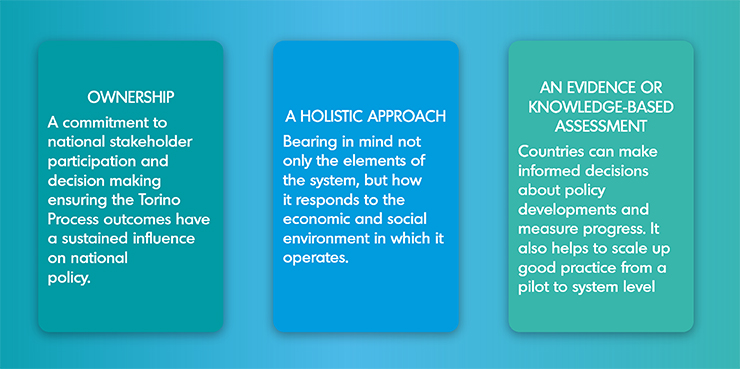
The Torino Process offers a holistic vision of the system. The way the various dimensions interact, and the importance given to the national context and cultural nuances are key components in building and assessing the system. It is about creating something greater that can be passed on to future generations, which is a lifelong learning system.
Key features of the Torino Process