
Young voices in Turin tackle skills, inclusion, and artificial intelligence
As the job market rapidly changes, driven by technological innovation and artificial intelligence, preparing young people for new opportunities while maintaining critical thinking, empathy and human values has become a major priority for policymakers and educators.
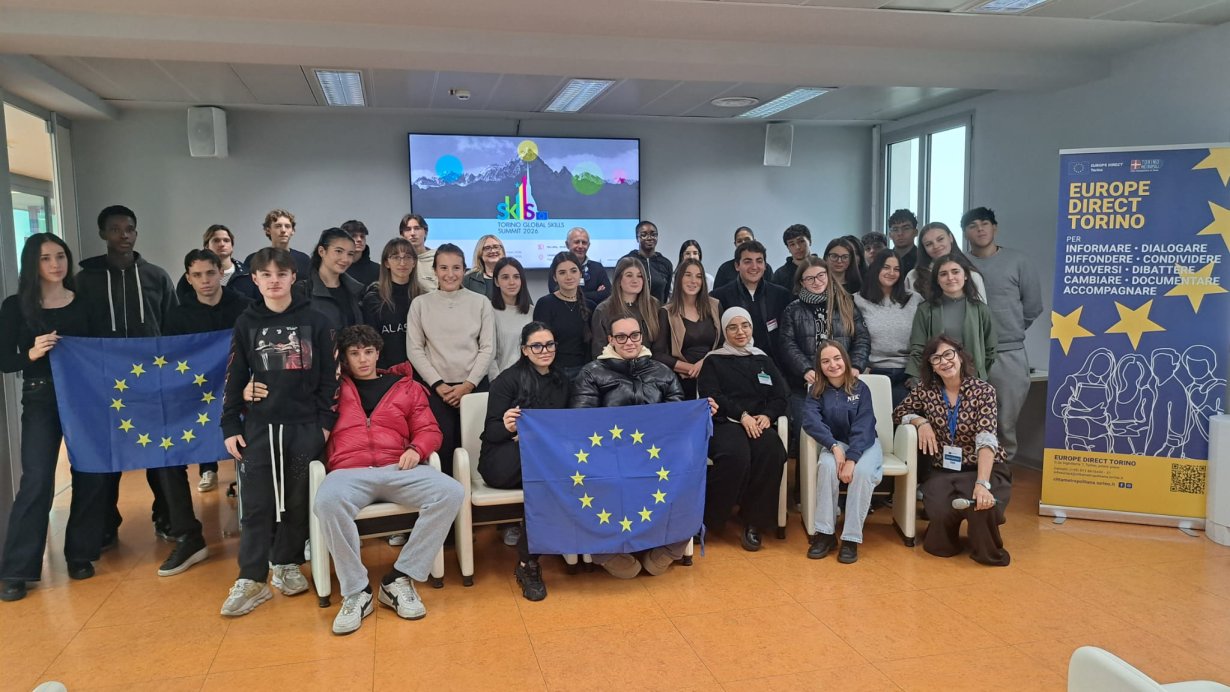
Europe Direct Torino brought high school students in Turin together with experts from the European Training Foundation (ETF) to talk about AI, jobs and the skills young people will need. The students came away with five proposals. They go to the European Commission’s Citizens’ Engagement Platform and will feed into the Global Skills Summit discussions.
Why do human skills matter more than ever?
Opening the session, ETF experts Alessandro Brolpito and Olena Bekh emphasised that European competencies are not abstract bureaucratic concepts, but practical tools for building trust, fostering peace, and navigating an uncertain future. While European achievements such as border-free travel, cross-border study opportunities, and abolished roaming charges are often taken for granted by younger generations, sustaining a competitive and inclusive Europe requires active participation.
Drawing on data from the World Economic Forum’s Future of Jobs reports, Olena Bekh illustrated how the skills landscape has shifted over the past decade. Alongside complex problem-solving and critical thinking, creativity, resilience, empathy, and lifelong learning have climbed to the top of employers' wish lists. In a world where a single school diploma is no longer enough for a lifetime career, learning how to learn—and maintaining human autonomy—is essential.
AI: tool or substitute?
A major focal point of the plenary debate was artificial intelligence. Invoking Descartes’ "I think, therefore I am," Alessandro Brolpito reminded students that AI is a statistical algorithm capable of simulating human language, not a conscious entity capable of genuine thought or moral judgment.
Through practical examples, including AI-generated images of Turin and prompts that exposed gender stereotypes in professions like mechanics and healthcare, the speakers demonstrated how AI can amplify human biases and blur the line between truth and fabrication. They also warned against over-reliance on AI for personal or emotional advice, urging young people to protect their data privacy and rely on real human connections. To counter these risks, the European Union is pioneering global standards through frameworks like the AI Act, which bans AI systems used to classify or discriminate against citizens.
Five student proposals submitted to the European Commission
Following the plenary session, students divided into five working groups, each tasked with presenting concise, three-minute UN-style pitches summarising their solutions for European policymakers:
- Learning by doing and innovation: Students called for more opportunities to travel, gain hands-on experience outside the classroom, and replace hyper-competitiveness with teamwork. They stressed the need for schools to actively teach critical thinking, creativity, and digital media literacy, supported by stronger cooperation between families and educators in guiding younger children online.
- Inclusion and equal opportunities: Challenging whether equal opportunity in education is a reality or a utopia, this group advocated for evaluation methods that reward reasoning and engagement rather than rote memorisation. They also called for lower costs for textbooks and school supplies to support low-income families, alongside extracurricular initiatives to combat cultural, socioeconomic, gender, and LGBTQ+ discrimination.
- Active citizenship and fighting disinformation: To tackle the spread of fake news on social media, students proposed an EU-backed verification app and certification "trust label" combining AI efficiency with human oversight and strict safety boundaries. Experts praised the shift toward holding digital platforms accountable while reminding students of the journalistic golden rule: always verify information across at least three independent sources.
- Overcoming stereotypes: Addressing migration and cultural prejudice, students emphasised that changing mindsets starts with shared cultural experiences and school exchange programs. When ETF experts asked how teachers could apply this principle, students said that they should be assessed on their knowledge and understanding of the subject, not on personal opinions or biases, as this would help build greater empathy and mutual respect in the classroom.
- AI in student life: Presenting a visual manifesto divided into Limits, School, Generations, and the EU, this group argued that schools must establish clear guidelines so AI supports learning rather than acting as a shortcut. They requested targeted training courses for both teachers and students, as well as strict boundaries to ensure AI enhances human work without replacing human empathy, craftsmanship, and moral judgment.
Empathy, ethics and collaboration are human skills machines cannot fully replicate
As the workshop concluded, speakers noted that transversals skills—such as empathy, ethical reasoning, and collaboration—remain uniquely human strengths that no machine can replicate. By uploading their proposals directly onto the European Commission's Citizens' Engagement Platform and contributing to the ED Voices survey, the students in Turin proved that when given the space and tools to think outside the box, young people are ready to help design the future of Europe.