
A Framework to Drive Adult Learning Reforms: Conference Report
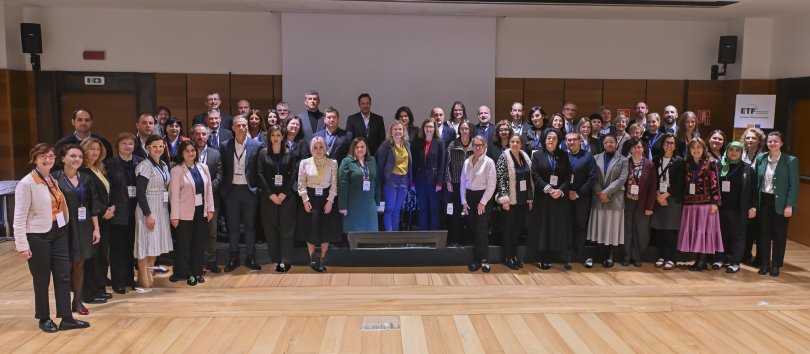
A two-day conference in Turin this week brought together 50 delegates from 10 Candidate and Neighbour countries with whom ETF works, and 6 EU member states, to discuss Adult Learning and Education (ALE).
Co-hosted by ETF and DVV, the German Adult Education Association, the gathering included high-level debates, brainstorming sessions and site visits.
Opening the event, Manuela Geleng, Directorate General for Employment, Social Affairs and Inclusion at the European Commission, underlined the urgency: “we’re confronting deep transformations – decarbonisation and digitalisation – and the demographics are not favourable. Our populations are ageing and if we want to remain competitive, and have the capacity to innovate, we need adults to reskill.”
The EU has set an ambitious target of 60% participation in ALE, but the current figure falls far short (39.5%). Funding is partly an issue, with ALE only accounting for an average 0.1% of GDP of member states. Candidate countries face the same challenges.
“Why should a country invest in adult learning?” asked Esther Hirsch, Director of DVV International. “It goes to the heart of what a nation is: it brings together a diversity of needs and is relevant for a stable, open society.”
Geleng reminded delegates that the first principle of the European Pillar of Social Rights is access to education and learning. The UNESCO World Conference on Adult Education in 2022 also declared that “adult education is part of the right to education and crucial for the realization of all human rights.”
Inclusivity emerged as one of the key themes of the opening morning. Felicia Bechtoldt, State Secretary at Moldova’s Ministry of Labour and Social Protection, spoke of “an opportunity to transform our societies, to make them more inclusive. We need to redefine competence as no longer an educational issue but a national priority for economic development and social cohesion. It’s about the dignity of every citizen.”
“Moldova”, she said, “has a large minority of Ukrainians and Russians, of Gagauz [ethnic Turks] and a large number of Bulgarians. We’re focusing on making our education accessible in the languages they speak, but it’s also important that they learn Romanian.”
“Adult learning is not just about economic development and increase of income”, said DVV’s Levan Kvatchadze, “but also about aspects not directly related to the labour market like active citizenship.” It was a point echoed by Claudio Maria Vitali from Italy’s National Institute for the Analysis of Public Policy: “When the low-skilled participate less, you have a problem that is not about human capital development but about democracy and participation.”
Even when ALE provision is adequate, there remains the issue of discoverability and take-up. “It’s important to address a fundamental question”, said Pilvi Torsti, ETF’s Director: “how do we break the trend that those adults who most need learning are least likely to access it? In my native Finland, there’s a targeted approach, for example making available childcare for mothers to allow them to attend trainings. You have to know who are you targeting.”
Nesrin Oruç Ertürk, Director of Izmir University’s Continuing Education Center, urged the importance of “promotion”: “go and get people, don't wait for them to come.” ETF’s Florian Kadletz concurred: “we need to reach out. In Norway they go into companies to prepare the field.”
Another challenge raised by delegates was the fragmentation of Adult Learning systems. “It’s difficult to overcome the silos”, said ETF’s Siria Taurelli. “Various ministries are involved in ALE and responsibilities may overlap or be in contrast” Ministries should have a common policy, recognising that life cycles, too, are less linear: “there are fewer predictable sequences in life”, said Taurelli. “It’s no longer ‘play, study, work, retirement’, it doesn’t work like that anymore. We could talk about not generations but perennials…”
Jan Kalenda, from Tomas Bata University in Czech Republic, agreed about fragmentation, but suggested that “adult learning systems are embedded in clusters, in the labour market and in civic society. If you change just one part of this system, you’ll see the interconnectedness. If we want to regulate fragmented provision it’s very important to have a system of coordination.” Maciej Lasota from the Ministry of National Education in Poland offered a good example: “we first reinforced inter-ministerial coordination and then moved on to create Task Forces on lifelong learning in every region.”
Coordination and co-creation with non-state actors was another key theme. “There has to be”, said Vesna Fabian, Head of Serbia’s Office for Dual Education and National Qualifications Framework, “a social partnership at national, regional and local levels involving different associations, the chambers of commerce and so on. A qualification law isn’t just for the educational sector, but about human resources, identifying labour market needs and creating a resurgence of skills and knowledge…”
Over the two days, real synergies emerged between EU and neighbouring countries regarding the challenges of adult learning. As well as discussions about governance, legal frameworks, data collection and analysis, delegates discussed funding – from tax credits to ring-fencing funding for adult learners – and teacher training.
“The quality of teachers and the accreditation of teachers is very important”, said Vitali. “We need cooperation with universities to rethink the curricula for teachers because we can’t face new problems with old methodologies.” Teacher-excellence was also raised by Heribert Hinzen, former Director of DVV: “we need even the best teachers to be professionalised.”
Innovative means to assess and finance skills were discussed, from micro-credentials to individual learning accounts. As well as skills shortages, many delegates discussed the skills recognition issue which is especially acute in an era of mass migrations.
Learning is clearly becoming increasingly important in the context of EU policy-making, but it is also being reimagined: no longer is it merely about the utilitarian preparation of employees, but something more holistic. “The joy of learning is very important”, said Taurelli. “And not just learning for work, but for life and for personal development. It’s about learning as a practise, as a culture. We know from experience and research that motivation for learning works when it’s a pleasure, not an imposed duty.”
“We need education in all areas throughout life”, said Hinzen. “We need places and institutions where adults can enjoy not just life-long learning, but also life-wide and life-deep learning.”
Did you like this article? If you would like to be notified when new content like this is published, subscribe to receive our email alerts.