
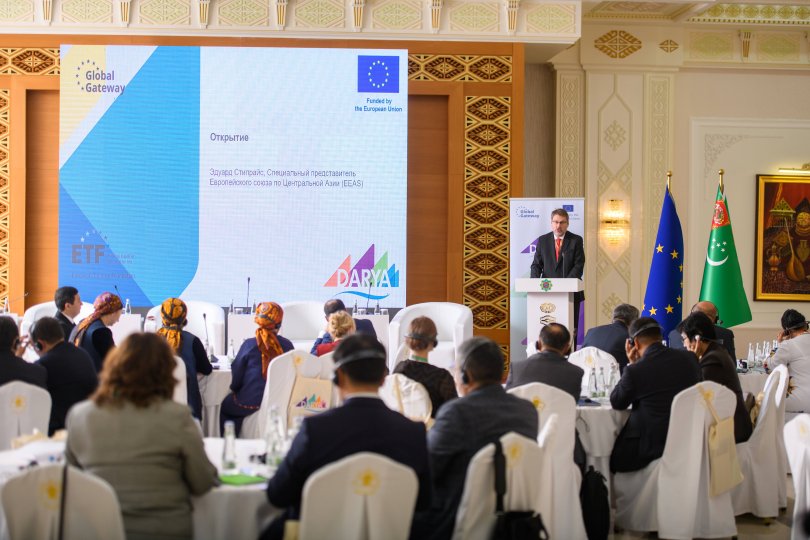
Twelve billion euros and the skills to spend them: Eduards Stiprais on DARYA and EU strategy in Central Asia
On the occasion of the fifth Dialogue and action for resourceful youth in Central Asia (DARYA) High-Level Group meeting, the EU Special Representative for Central Asia talks about EU Global Gateway investment in the region, the role of education and skills, and what he hopes to see in 2030.
Eduards Stiprais has been the European Union's Special Representative for Central Asia since 1 March 2025. The post is two decades old, created by a Foreign Affairs Council mandate in 2005, and it has rarely been busier. His first months in the job coincided with the first ever EU-Central Asia summit, held in Samarkand in April 2025, where the European Union placed twelve billion euros of Global Gateway investment on the table.
Stiprais knows the ground. A Latvian diplomat, born in Riga in 1969 and trained as an economist at the University of Latvia, Stiprais joined his country's diplomatic service in 1993 and has spent much of his career shuttling between Brussels, capitals in Europe and Central Asia. He was Latvia's Permanent Representative to the EU from 2004 to 2007, Ambassador to the United Kingdom from 2009 to 2013, and Undersecretary of State for Political Affairs until 2016. Then came four years in Tashkent as Head of the EU Delegation to Uzbekistan, followed by four in Paris as Ambassador to France and Monaco. Before this appointment he ran the Policy Planning Unit of the Latvian Ministry of Foreign Affairs.
His first direct involvement with the EU-funded DARYA programme came in October 2025, at the programme's fourth High-Level Group (HLG) meeting in Turin, Italy. More recently, on 13 and 14 October, he was in Ashgabat, Turkmenistan, for the fifth HGL meeting, the last under the current phase of the programme, which runs until 2027. The meeting centred on the skills needed for the Trans-Caspian Transport Corridor (TCTC), a transport route supported by the EU’s Global Gateway initiative that aims to connect Europe and Asia in no more than 15 days and to strengthen economic ties among Central Asian countries.
"For the European Union, DARYA is already a success"
Looking back over the past four years, which DARYA-supported achievements have been most valuable for the EU, and why?
Let me start with why Central Asia matters to the European Union at all. The first answer is connectivity: transport and energy, of course, but also human connectivity, people to people contact. In the case of Central Asia this is the absolute priority for sustainable economic and social development. Whatever is produced there has to reach world markets. Our Global Gateway initiative plays the biggest role in that, and the European Union has mobilised twelve billion euros in total for investment in the region.
But money by itself is not going to solve challenges of this size. These countries need technology, and more than technology, they need the knowledge and the skills to operate it. That is how they catch up with their peers, and in some areas perhaps even leapfrogging them. The Central Asian region is of strategic importance to us. We really need it to be stable economically, socially, politically, and from a security point of view.
DARYA and the European Training Foundation (ETF) bring together expertise from EU member states with existing and potential facilities in Central Asian countries. DARYA also brings together different layers of society, because this is not a purely educational issue. Business communities and other state institutions have to be involved. DARYA has built a better understanding, in Brussels and in Central Asian capitals, that educational outcomes have to go hand in hand with labour market needs, social inclusion and long-term economic development. My personal assessment is that for the European Union, DARYA is already a success.
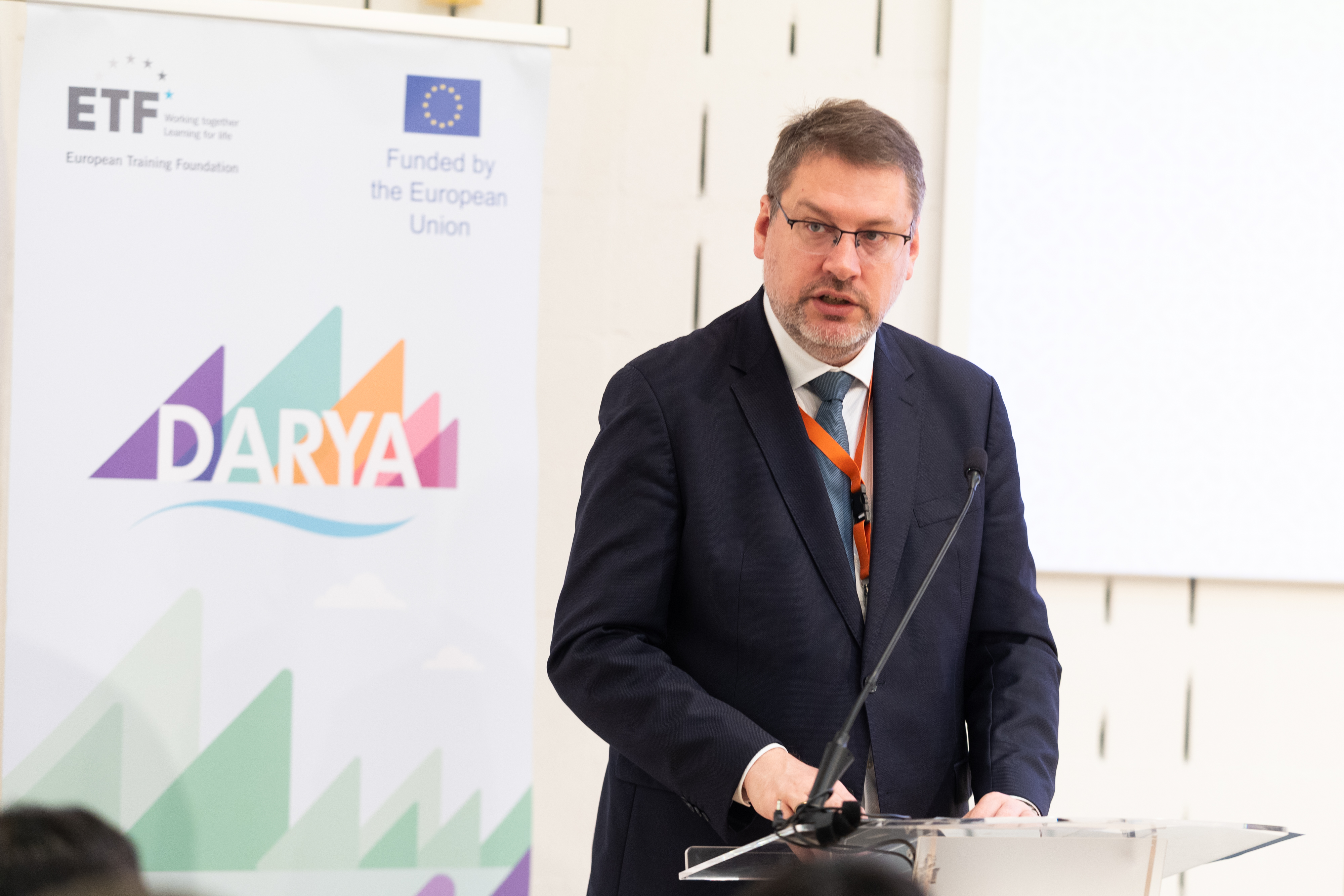
One of DARYA's strengths has been bringing countries together around shared challenges. What progress have you seen in regional cooperation on skills and education in areas linked to Global Gateway priorities, such as transport, energy or digital?
Regional cooperation inside Central Asia is picking up quite fast, and expanding. Last year the Deputy Ministers of Education and Labour from across the region gathered in Turin, and I had the privilege of attending that meeting. What I saw there was a growing understanding that the sectors tied to Global Gateway need more than infrastructure. Transport, energy, digitalisation, connectivity in the wider sense; all of them require a workforce skilled enough to support those transitions. That is important for us, and it is important for the Central Asian countries themselves.
In Turin, and Ashgabat this year, they had the chance to share experience, compare approaches and identify common challenges: modernising vocational education and training; improving qualification systems; strengthening links with employers; making education more inclusive and more responsive to the labour market. I would count that experience sharing as one of the major contributions of the DARYA programme.
The other thing I have been able to observe is that skills are now discussed in Central Asia in a more strategic way. Not simply as a matter for education, but as an indispensable ingredient of economic development, of competitiveness, and of the region's own integration. That is an increasingly positive shift. In Europe some countries reached that understanding a long time ago. For the rest it only became a serious issue over the last decade or so.
"If money is not spent wisely, there is no other money coming"
The ETF places a strong focus on evidence-based policymaking. How important are reliable skills intelligence and data for the region's development in Global Gateway priorities?
They are important because the resources in our hands, both in the European Union and in Central Asia, are finite. We are restricted in how much money we can dedicate. Twelve billion euros sounds mind boggling, but there are many, many competing priorities for it.
So, whatever we dedicate collectively, the European Union and the Central Asian countries together, to improving vocational training, should be based on evidence and thought through properly. If money is not spent wisely, there is no other money coming on top of that. Unfortunately, that is how it works.
This is why we need reliable data and the ability to forecast needs. Industry needs, and wider societal needs for qualified personnel. When resources are limited, the ability to forecast and then concentrate your effort where it is needed most becomes extremely important. Here I see another enormous contribution of the DARYA programme, and of the activities of the European Training Foundation in general.
“I would love to see the first graduates using the knowledge and skills transferred through DARYA”
If we were sitting here again in 2030, what would success look like for EU-Central Asia cooperation and Global Gateway priorities in education and training?
Four years is not much time. It is roughly the span of an extended training programme in a technical college or tekhnikum, the kind that usually runs in parallel with secondary education. So first and foremost, I would love to see the first graduates; young men and women who have been trained with the knowledge and the skills transferred through DARYA, and through the various bilateral programmes that many of our member states are implementing.
I want to see those young professionals joining the teams that are actually implementing Global Gateway projects, in their own countries and across their borders. By then I expect the Trans-Caspian transport corridor to be working, if not at maximum capacity then at a very considerable one. That means opportunities for businesses at both ends of the corridor. It also means highly qualified jobs for those graduates, the people who will keep Europe and Central Asia connected in a way that is sustainable, fast and reliable.
The second thing I would expect by then is that the Central Asian countries are much more active themselves in creating cooperative structures, accumulating their own experience and knowledge on how to run vocational education and professional training. So that there are already some gold nuggets we could source and bring back for our own use.
Did you like this article? If you would like to be notified when new content like this is published, subscribe to receive our email alerts.