
Shaping the architecture of skills recognition: insights from two DARYA events in Uzbekistan
Somewhere between a tractor driver's decades of field expertise and a hairdresser's mastery of her craft lies a problem that education systems across Central Asia have long struggled to solve: how do you formally recognise what people know, when nobody gave them a certificate for learning it?
That question sat at the heart of two consecutive events held in Tashkent in April 2026 under the DARYA project, an initiative of the European Training Foundation (ETF) funded by the European Union. Taken together, they offered a rare glimpse of regional reform in motion: methodical, collaborative, and increasingly urgent.
From assessors to architecture
The first event, a two-day training on 13 and 14 April, brought together around 50 practitioners from all five Central Asian countries — Kazakhstan, Kyrgyzstan, Tajikistan, Turkmenistan and Uzbekistan — to focus on the human core of Validation of Non-Formal and Informal Learning, or VNFIL: the assessor.
Led by Anni Karttunen of Globedu and Mika Heino from Omnia Education Partnerships, both based in Finland, the training was deliberately designed to resist the pull of the lecture hall. "From the very beginning, we aimed to move away from a traditional 'talking head' approach," Anni Karttunen noted. Instead of passive absorption, participants were placed at the centre of the learning: sharing national realities, challenging assumptions, and working through case studies on real-world professions — a cook, a locksmith, a waiter, a tractor driver.
Each group was asked to design a validation pathway for a typical candidate in their country and to select appropriate assessment methods. The exercise generated what Anni Karttunen described as "practical, context-driven" debate, with no single correct answer on offer: only approaches shaped by national realities and professional judgment.
The Finnish experience proved especially illuminating. Finland has developed one of the more mature VNFIL systems in Europe, strongly embedded in its vocational education and training system. The reflection on its architecture and the systems of Central Asia helped participants move from abstract principle to concrete possibility.
A dedicated session on the second day explored assessor competences in depth: not merely technical knowledge, but also the ethical grounding, communication skills and situational judgment required to perform the role fairly. A particularly resonant theme was the boundary between assessor and counsellor, two roles easily blurred in practice yet whose separation is essential to the integrity of any validation system.
A national conversation
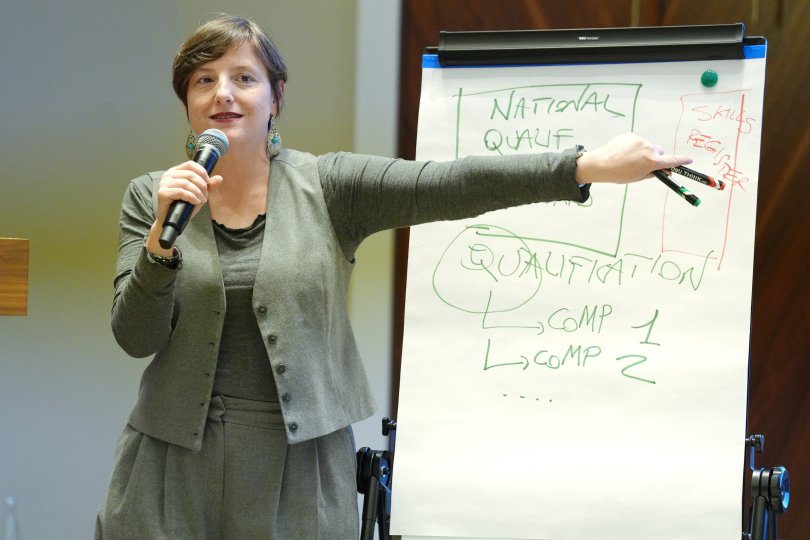
Just two days later, on 16 and 17 April, the focus shifted from practitioner capacity to systemic design. A national seminar, also co-organised under DARYA project by the ETF, the Institute for Development of the National Qualifications System of Uzbekistan and the UNESCO Office in Uzbekistan, brought together government officials, sector councils and validation centres to examine the institutional architecture of Uzbekistan's qualifications system.
Bakhtiyor Yuldashev, Director of the Agency for Quality Assurance in Education of Uzbekistan, framed the stakes plainly. "Starting from 2024, Uzbekistan began building a new qualifications system," he said. "As usual, implementing a new system requires two main actions: communication, and of course, learning from best practices. And today I am absolutely convinced that we are doing both." He was candid about the deeper challenge: "Changing the mindset of people is the most difficult moment for all of us."
That candour set the tone for two days of a very trust-based exchange. International experts from Italy, Ireland and Latvia sat alongside Uzbek practitioners: not to deliver pre-packaged solutions but to share the hard-won lessons of their own reform journeys.
Teresa Valentino, from the Regione Piemonte, offered perhaps the most useful cautionary tale. Piedmont began its validation experiment in 2015 with a modest budget and, crucially, without rushing to codify what it had not yet tested. "We wrote our guiding principles, our certification code, but we did not approve it," she explained. "First we experimented, with the text, with people, with operators. Only after the experiments did we return to the code, to the law, and finally approve it."
Over two years, Valentino personally travelled across the region conducting 50 workshops to explain the system to those who would implement it. Today, Piedmont has committed €6 million to its validation mechanisms through 2028. "This seminar gives a good opportunity to learn from those who have already faced certain problems," she said. "It can help avoid repeating mistakes."
The EU Delegation's Head of Cooperation in Uzbekistan, Christos Marazopolous, placed the work in a broader geopolitical frame. The European Union, he noted, is a committed partner in supporting education development "because by investing in this area we can support all the European investments we are attracting to Uzbekistan" — referencing the Global Gateway initiative and its focus on energy, water, critical minerals and transport corridors. "We are here to support this process and to ensure that these reforms truly bear fruit for society."
The connective tissue
What made the Tashkent sequence significant was not any single session but the logic linking the two events. The first built capacity at the level of the individual assessor, the person who in practice determines whether a candidate's informal competences are recognised or overlooked. The second addressed the systemic conditions that make such recognition meaningful: sector councils, qualifications frameworks, labour market forecasting and the microqualifications that may soon reshape how skills are certified in a rapidly digitalising economy.
Nadezda Solodjankina, ETF Human Capital Development Expert and thematic lead on DARYA qualifications area, captured the collaborative spirit that made the seminar possible. "The DARYA project and the EU support Central Asian countries in developing skills that meet the needs of the labour market and industries, and promote employability. When we proposed to colleagues from the Institute for NQS Development of Uzbekistan to organise a training seminar together, they enthusiastically took it up and suggested linking it to current processes and tasks in Uzbekistan's NQS."
What followed was a genuinely co-constructed programme, drawing on expertise from Italy, Ireland, Latvia and UNESCO, shaped by local ownership rather than imported prescription.
That distinction matters beyond Uzbekistan. Across Central Asia, qualification reform is happening simultaneously in five very different national contexts, and the temptation to import ready-made frameworks is real. What the Tashkent events demonstrated, instead, is a more patient and ultimately more durable model: one that builds regional solidarity through shared learning, and trusts practitioners to adapt what works elsewhere to what is genuinely needed at home. The architecture of recognition is being built and, under DARYA Module 2, the work continues until 2027.
Did you like this article? If you would like to be notified when new content like this is published, subscribe to receive our email alerts.