
Investing in the next generation: the ETF at the Ukraine Recovery Conference 2026
The fifth Ukraine Recovery Conference (URC2026), held in Gdańsk, Poland, on 25 and 26 June, gathered governments, financial institutions, business and civil society around a question that sharpens with every year of war: how to rebuild a country while it is still under attack. For the European Training Foundation (ETF), the EU agency that has worked alongside Ukrainian authorities on education, skills and employment since the country's independence, the answer starts with the generation that will inherit reconstruction.
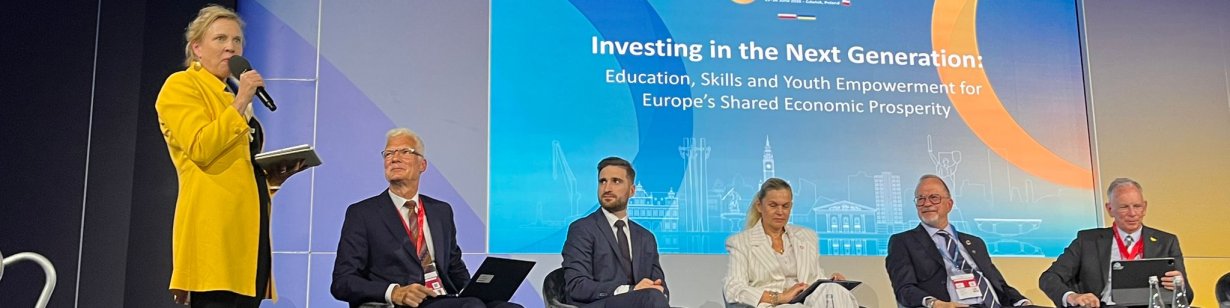
ETF Director Pilvi Torsti joined the high-level panel "Investing in the Next Generation: Education, Skills and Youth Empowerment for Europe's Shared Economic Prosperity", moderated by Andreas Schleicher, the OECD's Director for Education and Skills. The discussion brought Ukraine's education leadership together with the OECD, the World Bank, UNICEF, the Government of Japan and Poland's public and energy sectors. Alongside Torsti, Ukraine's First Deputy Minister of Education and Science, Yevhen Kudriavets, and Poland's Minister of Education, Barbara Nowacka, set out what it takes to keep schooling, skills and young people's prospects on the recovery agenda.
“Enlargement and investment are at the heart of today's discussion, and of human capital development over the long term. These reforms play out over a ten-year period, and EU accession gives them a framework; one that will matter just as much in a post-war Ukraine. Enlargement is also a prospect for our Union itself. Every investment in Ukraine is an investment in a future EU Member State,” said Torsti.
She went on to explain that since 2022, €1.1 billion in EU funding has gone into education and youth in Ukraine via Team Europe, and between 50,000 and 60,000 Ukrainians have taken part in Erasmus+ mobility. The Youth Guarantee carries that through, from school to the labour market. Both the Ukrainian and Polish ministers present underlined vocational education, with Ukraine having put its VET system through a sweeping reform that opens the door to reskilling and the recognition of qualifications, a decisive step within the enlargement framework.
If the panel set the strategic frame for discussions, the youth workshop showed why it matters. As part of discussions under the banner of "Generation of Recovery: Youth as a Driver of Ukraine's Recovery" (a roundtable convened with Ukraine's Ministry of Youth and Sports), Torsti set out how the EU Youth Guarantee is being adapted to a country at war. She was joined by Deputy Minister of Youth and Sports Uliana Tokarieva, an active figure in Ukraine's Inter-Agency Working Group on the Youth Guarantee, who had already taken part in the ETF's seminar on the scheme in Lisbon just over a month ago.
Perhaps the most telling contributions to discussions came from young people themselves. Among them were Anastasiia Wenger-Semenowycz, a seventeen-year-old who founded an NGO in Kraków to support Ukrainian youth at home and in exile, and Ruslan Topchan, a 22-year-old war veteran whose account of returning to civilian lent a truly human dimension to the word "resilience". Their presence alone was a powerful statement. The session closed with a joint communiqué built around a single rule, "nothing for youth without youth", and a commitment to reach the people the system usually misses, from displaced young people and returnees from the temporarily occupied territories, to young veterans and their families, and youth with disabilities.
Away from the sessions, Torsti held nearly ten bilateral meetings with the development agencies of Belgium, France, Germany, Poland, Estonia, Finland and Luxembourg. These are the same agencies that gathered at ETF headquarters in May, under the Team Europe initiative, to draft a joint results framework for vocational education and adult learning in Ukraine, a priority reinforced by Executive Vice-President Roxana Mînzatu, who announced an additional €10 million for the area following a high-level meeting with Ukraine's Minister of Education and Science, Oksen Lisovyi. The bilaterals in Gdańsk were a chance to turn that coordination into concrete next steps.
Close to two million young Ukrainians are not in employment, education or training, nearly seven in ten of them are women, and an estimated 1.2 million young people have left the country since February 2022, according to UNICEF data. A recovering economy cannot afford to lose them.
The Youth Guarantee anchors the response to this crisis, though it is just one piece of the puzzle. An EU policy since 2013, the guarantee commits authorities to offer every person under 30* who is out of work or education a quality opportunity (a job, training, an apprenticeship or a return to education) within four months. Ukraine has moved fast for a country engaged in active conflict. It has notably moved forward with an inter-ministerial working group (June 2024), a Law on the Basic Principles of Youth Policy (June 2025) – which transposed the guarantee into national legislation – and a national coordinator, which now steers the programme across different ministries.
The ETF has accompanied every step in this process through a knowledge-sharing programme coordinated with the European Commission, the International Labour Organisation (ILO), UNICEF and several Member States, including Estonia, Finland, Poland and Portugal. The latter have offered critical insight by sharing their experiences of what worked at home and, just as usefully, what did not.
Beyond the Youth Guarantees there is also a wider effort to tie youth to recovery and EU accession. This has culminated in a Rapid Education Diagnosis of Ukraine's system, with a report due in August 2026; the modernisation of vocational education as per national law, in effect since September 2025, which now situates most training programmes within real workplaces and comprises over 220,000 learners across various work-based programmes; teacher development through the EU Academy and the "SELFIE for teachers" tool; the alignment of Ukrainian qualifications with European standards; and career guidance offered to young people through platforms like Diia.Education. The Team Europe results framework, covering the years 2027 to 2029, also ties these initiatives to the Ukrainian government's own reform plans, rather than donors' priorities.
As a conduit between Kyiv and Brussels, the ETF has contributed to turning Ukraine's reform priorities into the language of EU instruments, and EU commitments into steps that Ukrainian institutions can take, working closely with the European Commission, the External Action Service and the EU delegation in Kyiv, as well as with other international organisations.
“The ETF's commitment to the Youth Guarantee, a flagship initiative for Ukraine and a cornerstone of its path towards the EU, is clear and unstoppable. Our focus on young people will continue, at the centre of the human capital work we have carried out as an EU agency in the country for more than thirty years,” said Torsti. "I want to commend the Ukrainian government for their resolve and steadfast efforts. The aim is simple: to leave no young person without a route towards education and employment, and to help each of them lay a brick in the country's reconstruction.”
“Every time someone tells young people they are the future," she added, "they should answer, "in fact, we are the present." The action starts now.”
*Ukraine has established its Youth Guarantee upper age limit at 35, in a bid to reach a broader range of people in need.
Did you like this article? If you would like to be notified when new content like this is published, subscribe to receive our email alerts.