
Skills Lab Network of Experts: From skills anticipation to policy action
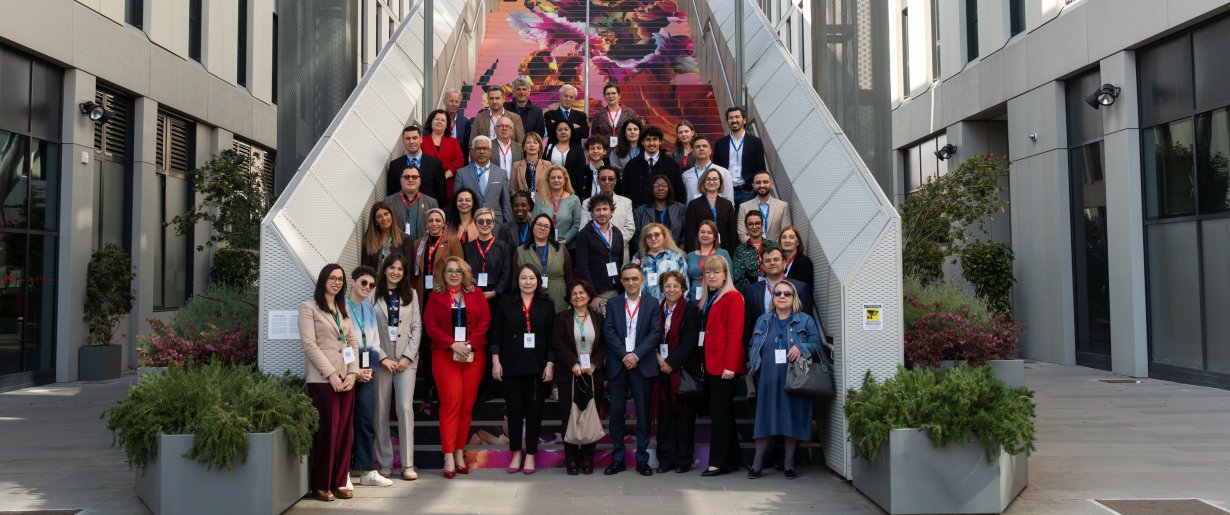
Anticipating the skills needs of the future and how to better utilise research to achieve policymaking action was the theme of a two-day event for the Skills Lab Network of Experts in Florence, Italy, on 25 and 26 March.
Over 40 researchers and policymakers gathered to discuss the challenges of forecasting labour market needs in a turbulent world, at a time of shake-ups caused by digital transformation and artificial intelligence (AI). The event was the fourth edition of the European Training Foundation (ETF) Skills Lab Network of Experts, which includes over 850 members in countries neighbouring the EU.
Bridging the gap and skills intelligence
In its skills demands analysis, the ETF has observed that high-quality research does not automatically lead to evidence-informed policies due to a disconnect between the evidence providers (researchers) and the evidence users (policymakers).
Speaking to this topic, ETF Director Pilvi Torsti said: “While the data is there, drawing on longstanding work on skills demand analysis, it does not necessarily translate into evidence for informed policies. The key challenge is the disconnect between science and policy. We need to develop and institutionalise effective dialogue mechanisms between institutions and policymakers, and present the evidence to have effective results. This is why the ETF network is valuable, as it brings these elements together... so we can make steps to bridge that gap on a somewhat permanent level.”
Torsti highlighted the Network’s role in exchanging knowledge, and the different approaches to labour monitoring and skills matching, as well as responses to skills demands, to contribute to evidence-informed policymaking in ETF partner countries.
With so much afoot in labour markets, and given the difficulties of assessing future skills needs, Torsti said a necessary first step is to turn labour market data into “what could be called skills intelligence”. This requires adjustments to data gathering and analysis, “so bridges are built from the data to intelligence, and for skills intelligence to be utilised.”
The seemingly widening gap in research and policy in the drafting and making of policies in Europe, the US and elsewhere was emphasised by H.E. Ambassador Armando Barucco, Secretary General of the European University Institute (EUI).
“I find myself more and more with ministers complaining about the quality of knowledge and research on which their policies are based. This is not just a problem in drafting policies, but a problem in the evidence and science behind law making,” said Ambassador Barucco. “This is a pressing issue with populist, rather than technocratic, governments as there is a heightened need for rigorous scientific evidence to steer policy”, he added.
Preserving human agency in the age of AI and the role of education
Recent ETF research on the impact of AI on labour markets and the implications for skills shows that there has not yet been a dramatic change in overall employment, but certain occupations are particularly affected. AI is simultaneously automating, augmenting, and redefining tasks and changing how work is performed and valued. Understanding its impact on jobs, working conditions and different social groups is essential to making the most of the opportunities it offers while reducing the risks.
While the debate about the impact of AI is ongoing, the EUI's Professor Vladimír Šucha said, in his keynote address, that while the governance gap in science and policy has been identified, what is “missing is the impact on cognition and human agency. We are simply not measuring it to know what the implications are.”
Šucha said that while skills for the AI era are essential, this should go beyond the educational skills needed to navigate AI in the workplace to include skills that reinforce mental resilience.
“We need to invest in technological self-awareness, attention management, emotional autonomy, deep relationships, communities, and compassion. Mental resilience should be a fundamental issue on which we are building skills”, said Professor Šucha.
He also warned that there is a need “to preserve what is being silently eroded” by AI. “We are sleepwalking into the total destruction of human society,” he said, noting the danger of AI to human agency. He emphasised the need for human capacities in judging options and evaluating policy options, as “if this is offloaded and delegated to AI, then policymaking is gone, and democracy is gone. It is idiocracy, AI governing society.”
Policy pitch
With challenges coming thick and fast, researchers and policymakers should be faster to respond, said Peter Bosch, Senior Associate Fellow in the European Affairs programme at the Egmont Institute, in a keynote speech. “It is important we have regular annual updates on shortages in occupations, but as things are speeding up so rapidly, can we do it in six months? I don’t know, but we need to speed up the work,” he said.
He offered some solutions to bolster the research-policy nexus by advocating that researchers directly connect with policymakers before embarking on projects. “Talk to them or write to them. It is also in their interest to know the research you do,” he said.
In addition, he promoted the ‘policy pitch’ approach, which brings together researchers and policymakers in one room to discuss four or five topics, with each researcher getting five to 10 minutes to make a pitch. “In that way, they can know what the policymaker is thinking and how to represent ideas or proposals,” he said.
To Skills Lab Network members, Bosch said knowing the complexities of the European Commission is key for policy pitches, but also that Europe should listen to others in developing effective skills policies.
“Direct experiences of the realities of the third-party countries in the Network is absolutely crucial for policymakers to make sense of the countries concerned. EU policymakers should be in the room listening to them, and then go to the drawing boards in Brussels. The Network is a unique opportunity to strengthen the voice of our partner countries”, said Bosch.
Did you like this article? If you would like to be notified when new content like this is published, subscribe to receive our email alerts.