
Four days in Turin: building a shared future for Palestine's TVET teachers
How a dialogue between Palestinian institutions turned a fragmented system into a shared plan
Teachers are the single biggest factor in whether any education reform actually reaches a classroom. This is especially true in vocational education and training (VET), where the quality of instructors determines whether young people leave with skills employers actually need. In Palestine, however, the people responsible for training the country's TVET teachers and trainers have long worked across separate, disconnected systems — some following a structured national pathway, others left largely to project-by-project support.
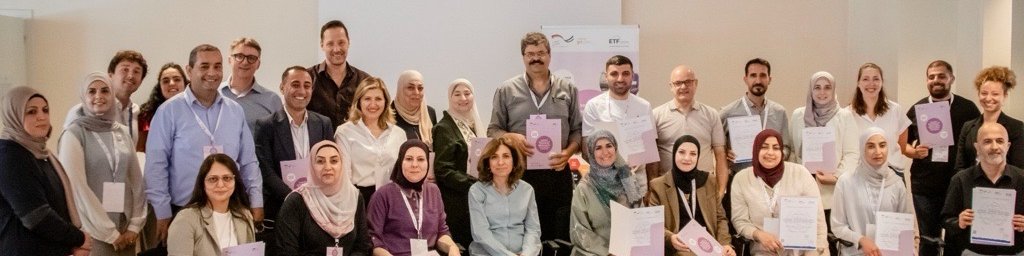
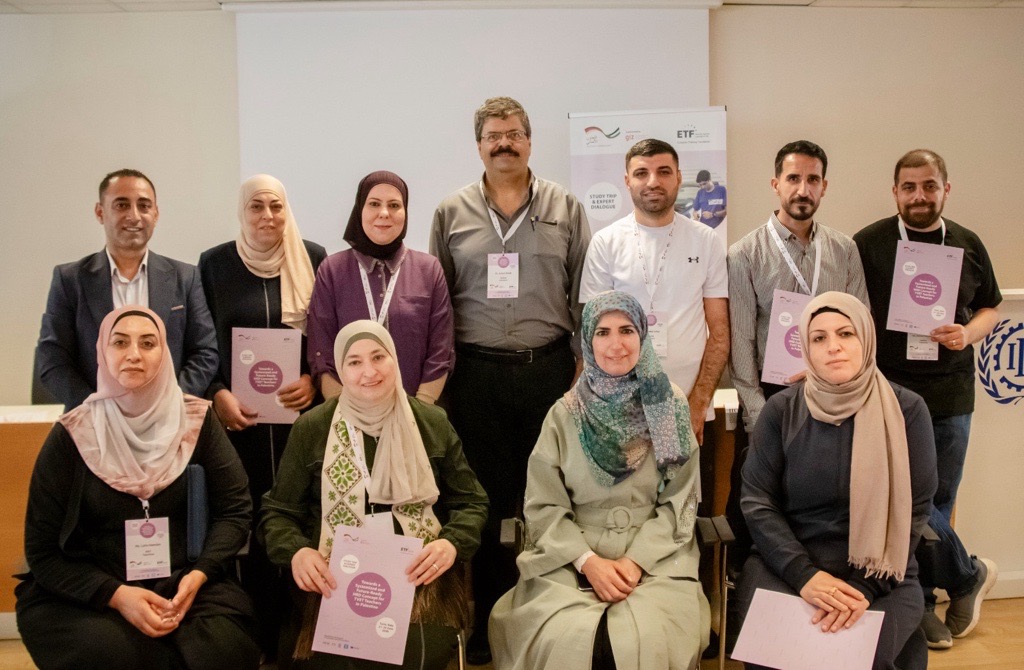
From 21 to 24 June 2026, that started to change. In Turin, Italy, representatives of Palestine's Ministry of Education and Higher Education, Ministry of Labour, National Institute for Educational Training (NIET), the Accreditation and Quality Assurance Commission (AQAC), UNRWA and UNESCO sat down with the European Training Foundation (ETF) and the International Training Centre of the ILO (ITCILO), convened by GIZ Palestine, to do something rarely attempted in a single workshop: design the outline of a national system, not just discuss its problems.
A system built on good intentions, but no shared architecture
Palestine's TVET teachers currently develop their careers along two very different tracks. Teachers in Ministry of Education-affiliated vocational schools are increasingly supported through a structured professional diploma pathway delivered by NIET. Trainers linked to the Ministry of Labour, and instructors in technical colleges, depend far more on ad hoc, project-based training, often disconnected from any shared competence framework or recognised qualification. UNRWA, meanwhile, runs its own separate model for its own institutions.
When professional development isn't anchored in common standards, it becomes difficult to recognise a teacher's learning, hard to build a career path around it, and easy for good training to disappear the moment a project's funding ends.
Key context: MoEHE-linked teachers already follow a structured diploma pathway through NIET; MoL-linked trainers and technical-college instructors still rely largely on project-based development with no shared framework.
Four groups, working independently, arrived at (almost) the same answer
The most striking outcome of the Turin dialogue is how much four separate groups agreed on, without being told to. Working through seven "Concept Design Labs," four parallel groups, each representing a different institutional perspective, independently produced vision statements, competence frameworks and governance proposals for a future TVET teaching workforce.
Despite using different words, all four visions converged on the same underlying priorities: teacher empowerment, quality, innovation and a stronger link between training and employment. All four groups also converged on the same five competence domains:
- pedagogical skill,
- technical updating,
- digital and AI-enabled teaching,
- green skills,
- inclusive teaching
They also agreed on the same institutional roles: the National TVET Commission for policy oversight, NIET for delivery, and AQAC for accreditation.
"Professional development should not be organised in isolated workshops or donor-driven activities — it should be part of a coherent national system, with clear professional standards and partnership with universities. Training must be based on teachers' actual needs, leading to career professionalism… Investing in teachers is investing in the quality of education and the future of Palestine." — Dr Rabah Morrar, Head of the National TVET Commission of Palestine
A career path with names and faces
Rather than sketching an abstract ladder, participants designed the pathway around four real career stages, each represented by a named persona. Layla, an entry-level teacher, needs support with classroom management and induction. Omar, mid-career, needs modular learning and mentoring linked to stackable micro-credentials. Rana, a specialist, needs recognised pathways that connect to higher education and industry. Tariq, a senior leader, needs coaching, strategic planning and quality-assurance skills.
Despite representing very different career stages, all four personas ran into the same barriers, such as limited time, weak recognition of prior learning, and restricted access to opportunities. This is a signal that these are systemic problems, not individual ones.
"Rana needs access to high quality, recognised professional development opportunities that support her career advancement and academic progression... while also finding accessible and accredited pathways that are valued by employers and higher education institutions." — Working Group 3, Lab 2
A working model already exists, at scale
A concrete reference discussed in Turin came from UNRWA, whose Professional Development Programme has already moved from a single exam-based qualification to a modular, competency-based system covering both teaching and administrative staff.
Key stat: UNRWA's programme runs 33 training units across 10 modules, reaching 944 staff posts across eight Vocational Training Centres — which enrolled 7,105 students in 2025/26, with 83.8% of graduates in employment in 2025 (excluding Gaza).
For a national concept still working out how training from different institutions should stack into recognised, accredited qualifications, UNRWA's experience is a practical proof point that a modular, competency-based system can function at real institutional scale.
What still needs to be resolved
Participants were also honest about issues that remained unfinished. One working group's proposal overlapped with AQAC on accreditation responsibilities, an issue still requiring clarification. Groups also identified different priority risks going forward, from limited stakeholder consensus and weak data systems, to the security situation itself. And one participant noted that governance discussions, in particular, could have used more time.
"The workshop was excellent in terms of logistics, organisation, and the way activities were conducted. However, more time could have been dedicated to governance and policy discussions." — Hanan Jabriel, Supervisor and Trainer, NIET
These are exactly the kinds of details that separate a promising concept from a durable national system, which is why they are being carried forward, rather than left behind.
From shared design to national ownership
When sides agree on their ambition, the focus should then shifts on what lies ahead. The next phase includes refining the HRD concept into a policy paper, validating it with labour-market and institutional stakeholders, signing a multi-party agreement between ministries and UNRWA, securing sustainable financing, and piloting the concept in selected institutions, with an initial endorsement target around the end of 2026.
As the report notes, what made the week feel different was that policy-level actors, human capital development experts, and international partners such as ITCILO and the ETF sat around the same table long enough to walk away with a first draft.
A partnership built for the long run
The ETF brought a system-reform lens to the dialogue, looking beyond training content to the institutional conditions that make training matter: governance, standards, recognition, quality assurance and data. Working alongside ITCILO's peer-learning expertise and GIZ Palestine's connection to national implementation, the ETF supports Palestine, as it does other partner countries, in turning fragmented professional-development efforts into coherent, nationally owned systems.
Did you like this article? If you would like to be notified when new content like this is published, subscribe to receive our email alerts.