
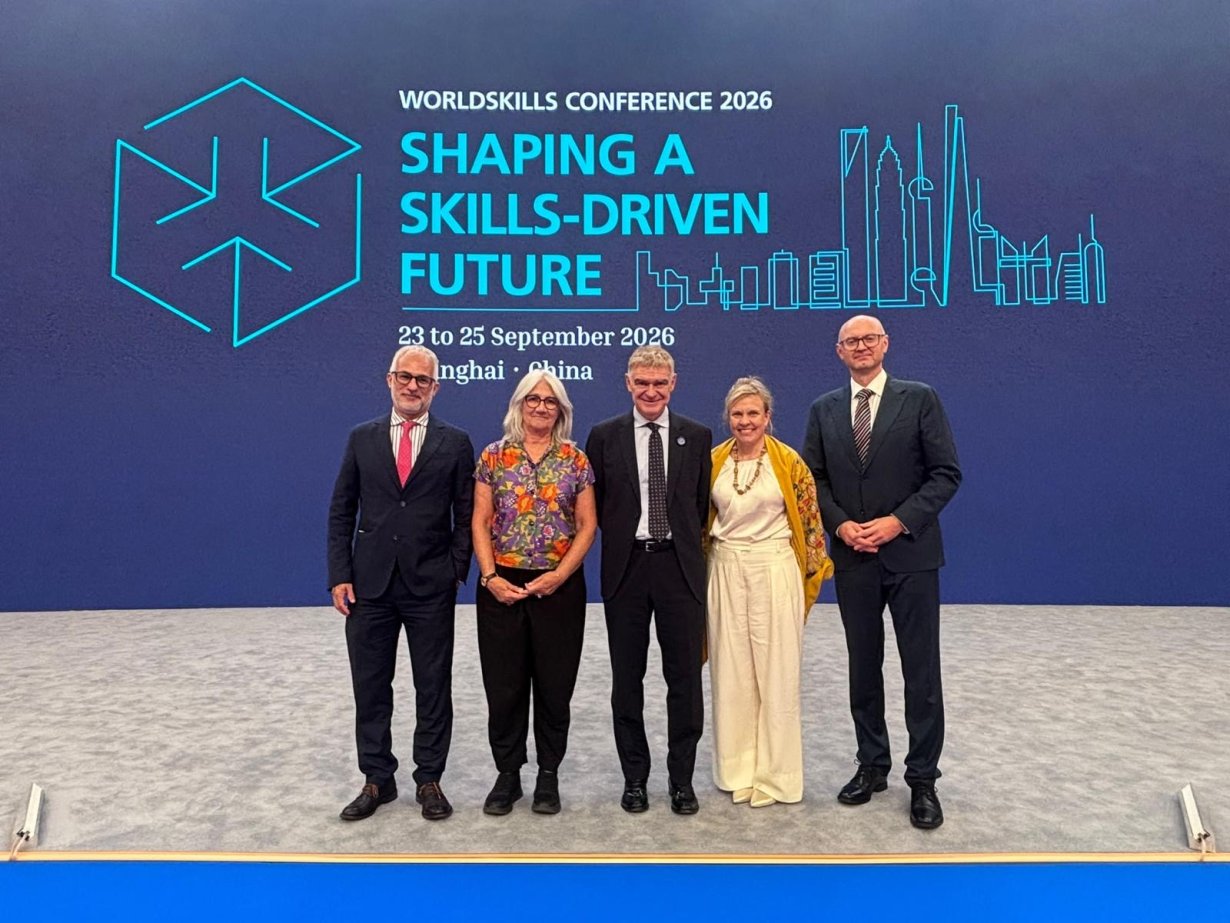
International cooperation holds the key to AI-age skills and the pace of technological change, confirms the ETF visit to Shanghai
International cooperation is the only way to build the skills and tools needed to keep pace with artificial intelligence and rapid technological change. That was the clear message from the European Training Foundation’s mission to WorldSkills2026 in Shanghai last week.
An ETF delegation led by director Pilvi Torsti joined the European Commission delegation headed by Mario Nava, Director-General for Employment, Social Affairs and Inclusion. at the WorldSkills 2026 Competition and Conference, held from 21-27 September.
WorldSkills, which leads a global drive to develop the skills people need in the age of AI, brought together governments, businesses, practitioners and training leaders from around the globe for the week-long event.
The ETF, a regular participant in skills competitions worldwide, travelled to China’s largest city and commercial hub as a partner in the German-led Towards a Global TVET Agenda (TGTA) initiative.
For Torsti, the 48th WorldSkills competition was an obvious place to be. “Shanghai is the natural place to be if you are an organisation working in human capital development at global level,” she said. Being part of Team EU at WorldSkills was particularly timely for a European agency like the ETF, coming just before the announcement of a new European Strategy for Vocational Education and Training.
“It is a big platform for networking and inspiration, combining policy discussions with a competition where skills can be demonstrated at the highest level,”
Says Georgios Zisimos, Head of the ETF’s Policy Advice Unit.
The speed at which AI is advancing and reshaping the skills landscape dominated the debate at the conference, with speakers weighing up its “hopes and fears”. Opening the conference, Chinese Premier Li Qiang said AI was one of the forces now shaping China’s approach to training and upskilling.
Li Qiang was standing in for Chinese president Xi Jinping, who was in Washington DC for talks with US President Donald Trump on trade and AI.
“China has always been committed to cultivating skills,” he said, calling for “closer international exchanges and cooperation on skills development.”
The “new round of technological revolution and industrial transformation” was profoundly reshaping global demand for skills, he added, and more education on AI was needed to support that change and promote “high-quality employment.”
The ETF delegation held several bilateral meetings on international partnerships, including talks with India’s Ministry for Skill Development and Entrepreneurship. The two sides discussed early plans to work with the National Skill Development Corporation (NSDC) ahead of the India-EU High-Level Dialogue .
The delegation also visited Tongji University in Shanghai, and was hosted by Vice Dean Min Junying and Professor Zhao Jin. Founded in 1907 by a German doctor, Tongji has kept close ties with Europe ever since. Discussions focused on closing the AI skills gap, building stronger links between employers and schools, and the challenges and benefits of AI in education and training.
In Beijing, Torsti met members of the China chapter of Eisenhower Fellowships, the US-based leadership network founded in 1953. The group, which includes leaders from government, business and academia, exchanged views with the ETF on how skills and training systems can keep up with fast-moving industries such as advanced manufacturing and engineering, and on the role of entrepreneurship and work-based learning.
At several debates, the ETF presented its role in the TGTA initiative, where its focus is on excellence partnerships. The aim is to build shared tools and a common space for cooperation, with vocational excellence as the theme and centres of excellence as the model.
The event also showed how much depends on major companies and international organisations in skills training, with Siemens, the OECD, the World Bank, the ILO and UNESCO among those taking part.
“Skills are becoming more and more important and are essential in different policy areas,” said Torsti.
The ETF joined several global players at a meeting aimed at strengthening cooperation between international organisations.
“Skilling and upskilling cannot be taken up by one country alone” she explained. “The role of big enterprises such as Siemens is key to how AI is introduced and how its impact on jobs is managed”.
Torsti, a former Finnish MP and State Secretary, brings long experience of education and employment policy to her role. In Shanghai she attended a range of meetings including a TGTA panel discussion on creating the conditions necessary to work in today’s global market.
She said the “new reality” that emerged during the Covid-19 lockdowns had become a lasting part of how we can work, because it “increases our ability and supports our need to work together, and internationally on all the various digital platforms. “This may sound like common sense but has actually been a game-changer, as education and training practioners have typically worked in national systems without much access to global cooperation. Now we can address questions such as AI in education or green skills together in a systematic way.”
Did you like this article? If you would like to be notified when new content like this is published, subscribe to receive our email alerts.